
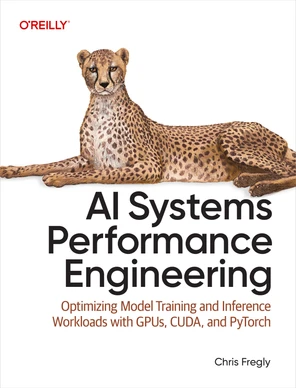
کتاب مهندسی عملکرد سیستمهای هوش مصنوعی
این کتاب راهنمای قطعی برای به حداکثر رساندن کارایی در تمامی لایههای زیرساخت هوش مصنوعی است. در عصر مدلهای مولد (Generative Models) که به سرعت در حال رشد هستند، این منبع به مهندسان، محققان و توسعهدهندگان مجموعهای عملی از استراتژیهای بهینهسازی ارائه میدهد. با یادگیری همزمان (Co-optimization) سختافزار، نرمافزار و الگوریتمها، میتوانید سیستمهای هوش مصنوعی منعطف، مقیاسپذیر (Scalability) و مقرونبهصرفه بسازید که در آموزش و استنتاج (Inference) عملکرد عالی دارند. این کتاب شامل روشهای گامبهگام برای تنظیم دقیق هستههای CUDA، الگوریتمهای مبتنی بر PyTorch و سیستمهای آموزش و استنتاج چندگرهای است. همچنین هنر مقیاسپذیری کلاسترهای GPU برای کارهای توزیعشده و سرورهای استنتاج را خواهید آموخت. در پایان، یک چکلیست شامل بیش از ۱۷۵ مورد بهینهسازی اثباتشده و آماده استفاده ارائه شده است.
اشتراکی
فصل های کتاب
با مرور فصلها، ساختار ، محتوای کتاب را به سرعت بشناسید.
با مرور فصلهای این کتاب میتونی خیلی سریع بفهمی هر بخش چی یاد میده، ساختار کلی چطوره و از کجا باید شروع کنی. هر فصل روی یک مفهوم یا مهارت خاص تمرکز داره و موضوعات اصلیش رو میبینی تا انتخابت آگاهانهتر باشه. چه بخوای کل کتاب رو دنبال کنی، چه فقط یک بخش خاص رو دنبال کنی، این نما کمکت میکنه مسیرت رو پیدا کنی.
مقدمه و بررسی کلی سیستمهای هوش مصنوعی
The AI Systems Performance Engineer • Benchmarking and Profiling • Scaling Distributed Training and Inference • Managing Resources Efficiently • Cross-Team Collaboration • Transparency and Reproducibility • DeepSeek Scales to ~680-Billion Parameter Models Despite US Export Hardware Restrictions in China • Toward 100-Trillion-Parameter Models • NVIDIA’s “AI Supercomputer in a Rack” • Mechanical Sympathy: Hardware-Software Codesign • Measuring “Goodput” Useful Throughput • Book Roadmap and Methodology • Key Takeaways • Conclusion
درحال تولید...
بررسی کلی سختافزار سیستمهای هوش مصنوعی
The CPU and GPU Superchip • NVIDIA Grace CPU • NVIDIA Blackwell “Dual-Die” GPU • NVIDIA GPU Tensor Cores and Transformer Engine • Streaming Multiprocessor, Threads, and Warps • Ultrascale Networking Treating Many GPUs as One • NVLink and NVSwitch • Multi-GPU Programming • In-Network Aggregations with NVIDIA SHARP • Multirack and Storage Communication • Preintegrated Rack Appliance • Co-Packaged Optics: Future of Networking Hardware • Compute Density and Power Requirements • Liquid Cooling Versus Air Cooling • Performance Monitoring and Utilization in Practice • Sharing and Scheduling • ROI of Upgrading Your Hardware • A Glimpse into the Future: NVIDIA’s Roadmap • Blackwell Ultra and Grace Blackwell Ultra • Vera Rubin Superchip (2026) • Rubin Ultra and Vera Rubin Ultra (2027) • Feynman GPU (2028) and Doubling Something Every Year • Key Takeaways • Conclusion
درحال تولید...
تنظیم سیستمعامل، داکر و کوبرنتیز برای محیطهای مبتنی بر GPU
Operating System • NVIDIA Software Stack • GPU Driver • CUDA Toolkit and Runtime • CUDA Forward and Backward Compatibility Across GPU Hardware Generations • C++ and Python CUDA Libraries • PyTorch and Higher-Level AI Frameworks • Configuring the CPUs and OS for GPU Environments • NUMA Awareness and CPU Pinning • NUMA-Friendly Memory Allocation and Memory Pinning • Transparent Hugepages • Scheduler and Interrupt Affinity • Virtual Memory and Swapping • Filesystem Caching and Write-Back • CPU Frequency and C-states • Tune Host CPU Memory Allocator • GPU Driver and Runtime Settings for Performance • GPU Persistence Mode • MPS • MIG • GPU Clock Speeds and ECC • GPU Memory Oversubscription, Fragmentation, and Out-of-Memory Handling • Container Runtime Optimizations for GPUs • NVIDIA Container Toolkit and CUDA Compatibility • NVIDIA Container Runtime • Avoiding Container Overlay Filesystem Overhead • Reduce Image Size for Faster Container Startup • Kubernetes for Topology-Aware Container Orchestration and Networking • Orchestrating Containers with Kubernetes Topology Manager • Job Scheduling with Kubernetes and SLURM • Slicing a GPU with MIG • Optimizing Network Communication for Kubernetes • Reducing Kubernetes Orchestration Jitter • Improving Resource Guarantees • Memory Isolation and Avoiding the OOM Killer • Dealing with I/O Isolation • Key Takeaways • Conclusion
درحال تولید...
تنظیم ارتباطات شبکهای توزیعشده
Overlapping Communication and Computation (Pipelining) • Asynchronous Execution with Streams • Reducing Communication Frequency and Volume • Achieving Maximal Overlap in Practice • NVIDIA Magnum IO Optimization Stack • High-Speed, Low-Overhead Data Transfers with RDMA • Tuning Multinode Connectivity • Multinode Communication Pitfalls • NCCL for Distributed Multi-GPU Communication • Topology Awareness in NCCL • NCCL Communication Algorithms • Distributed Data Parallel Strategies • NCCL Communicator Lifecycle and Environment Gotchas • Profiling and Debugging NCCL • In-Network SHARP Aggregation • Persistent NCCL User Buffers and Zero-Copy Registration • NVIDIA’s NIXL and Disaggregated Inference • Separate Prefill and Decode Inference Stages • Intelligent Interconnect Routing for KV Cache Transfers • NIXL Asynchronous API with Callbacks • KV Cache Offloading with NIXL • NIXL and High-Performance Inference Systems Like NVIDIA Dynamo • NCCL Versus NIXL • Key Takeaways • Conclusion
درحال تولید...
بهینهسازیهای ورودی/خروجی ذخیرهسازی مبتنی بر GPU
Fast Storage and Data Locality • Sequential Versus Random Read Patterns • Tuning NVMe and Filesystem for Throughput • Using NVIDIA GDS • Checkpointing GPU State with cuda-checkpoint • Measuring GDS with gdsio • DeepSeek’s Fire-Flyer File System • Distributed, Parallel Filesystems and Object Stores • Tuning, Replicating, and Compressing Data • Monitoring Storage I/O • Tuning the Data Pipeline • Efficient Data Loading and Preprocessing • Scaling Out Workers as You Scale Out Number of GPUs • Multimodal Data Processing with NVIDIA DALI • Creating High-Quality LLM Datasets with NVIDIA NeMo Curator • Continuous Profiling and Tuning Workflow • Diagnosing Communication- Versus Compute-Bound Workloads • Key Takeaways • Conclusion
درحال تولید...
معماری GPU، برنامهنویسی CUDA و به حداکثر رساندن اشغال
Understanding GPU Architecture • Threads, Warps, Blocks, and Grids • Choosing Threads-per-Block and Blocks-per-Grid Sizes • CUDA GPU Backward and Forward Compatibility Model • CUDA Programming Refresher • Configuring Launch Parameters: Blocks per Grid and Threads per Block • 2D and 3D Kernel Inputs • Asynchronous Memory Allocation and Memory Pools • Understanding GPU Memory Hierarchy • Unified Memory • Maintaining High Occupancy and GPU Utilization • Tuning Occupancy with Launch Bounds • Debugging Functional Correctness with NVIDIA Compute Sanitizer • Roofline Model: Compute-Bound or Memory-Bound Workloads • Key Takeaways • Conclusion
درحال تولید...
پروفایلگیری و تنظیم الگوهای دسترسی به حافظه GPU
Coalesced Versus Uncoalesced Global Memory Access • Vectorized Memory Access • Tiling and Data Reuse Using Shared Memory • Avoid Shared-Memory Bank Conflicts • Warp Shuffle Intrinsics: Avoid Shared Memory and Explicit Synchronization • Read-Only Data Caches • Asynchronous Memory Prefetching and Tensor Memory Accelerator • Key Takeaways • Conclusion
درحال تولید...
تنظیم اشغال، کارایی Warp و موازیسازی در سطح دستورالعمل
Profiling and Diagnosing GPU Bottlenecks • Nsight Systems Timeline View • Profiling and Tuning the Data Pipeline • Nsight Compute and Roofline Analysis • PyTorch Profiler and Visualization Tools • Profiler-Guided Analysis • Analyzing Warp Stall Reasons with Nsight Compute • Memory-Related Stalls • Execution-Dependency Stalls • Execution Unit Contention • Other Stall Reasons • Inspecting Achieved Occupancy and GPU Utilization • Kernel Memory Throughput Versus Peak HBM Memory Bandwidth • Kernel Compute Throughput Versus Peak GPU FLOPS • Iteratively Profiling and Determining the Kernel Bottleneck • Optimizing the Kernel • Tuning Occupancy • Find the Right Occupancy for Your Workload • Techniques for Occupancy Tuning • Compiler Hints to Optimize Occupancy • Determine Optimal Launch Configuration with the Occupancy API • Tuning Occupancy with PyTorch • Improving Warp Execution Efficiency (Warp Divergence) • Causes of Warp Divergence • Techniques to Avoid Warp Divergence • Profiling and Detecting Warp Divergence • Using Predication to Minimize Divergence • Efficient Intrawarp Communication with Warp Intrinsics • PyTorch Considerations for Warp-Level Efficiency • Exposing Instruction-Level Parallelism • Warp Scheduling and Dual Issue Instructions • ILP and Occupancy • Loop Unrolling, Interleaving, and Compiler Hinting • Profiling and Mitigating Register Pressure • Key Takeaways • Conclusion
درحال تولید...
افزایش کارایی هسته CUDA و شدت محاسباتی
Multilevel Microtiling and Software Prefetching • Tiling with Thread Block Clusters • Kernel Fusion • Structured Sparsity • Recomputation Versus Memory Trade-Off • PyTorch and Arithmetic Intensity • Mixed Precision and Utilizing Tensor Cores • Feeding Tensor Cores with TMEM and TMA • TF32 and Automatic Mixed Precision (PyTorch) • BF16/FP16, FP8, and FP4 Reduced Precision • INT8 Reduced Precision and DP4A Instructions for Inference • Transformer Engine and TMEM in Depth • Using CUTLASS for Optimal Arithmetic Intensity and Tensor Core Performance • Inline PTX and SASS Tuning for Microoptimizations • DeepSeek’s Use of Inline PTX for Memory Allocation Optimization • Key Takeaways • Conclusion
درحال تولید...
خطلولهسازی درونهستهای، تخصصیسازی Warp و خوشههای بلوک رشتهای تعاونی
Intra-Kernel Pipelining Techniques • Cooperative Tiling and Double-Buffering with the CUDA Pipeline API • Warp Specialization and the Producer-Consumer Model • Using CUDA Pipeline API for Warp Specialization • PyTorch, CUDA Pipeline API, and Warp Specialization • Persistent Kernels and Megakernels • Common Workloads for Persistent Kernels • Megakernels for Inference • Persistent Kernels and Warp Specialization • Cooperative Groups • Cooperative Grid Synchronization and Persistent Kernels • When to Combine Persistent Kernels and Cooperative Groups • Thread Block Clusters and Distributed Shared Memory • Thread Block Swizzling • Distributed Shared Memory • Scratch Memory • Launching a Thread Block Cluster • Coordinating Thread Block Clusters with Cooperative Groups API • Thread Block Pair • Reducing Global Memory Traffic with Thread Block Clusters • Designing Efficient Algorithms with Thread Block Clusters • Warp Specialization with Thread Block Clusters • Key Takeaways • Conclusion
درحال تولید...
خطلولهسازی میانهستهای، همگامسازی و تخصیص حافظه مرتبشده با جریان CUDA
Overlapping Kernel Execution with CUDA Streams • Using Streams to Overlap Compute with Data Transfers • Stream-Ordered Memory Allocator • Using CUDA Streams and Stream-Ordered Memory Allocator with LLMs • Legacy Default Stream • Modern Per-Thread Default Stream • Default Versus Explicit (Nondefault) Streams • Best Practices for Default Stream Usage • Fine-Grained Synchronization with Events and Callbacks • Using CUDA Events for Cross-Stream Synchronization • Pipelining with Warp Specialization (Intra-Kernel) and CUDA Streams (Inter-Kernel) • Warp Specialization with Thread Block Clusters and CUDA Streams • Multi-GPU Compute and Data Transfer Overlap with CUDA Streams • Programmatic Dependent Launch • Combining PDL and Thread Block Clusters with Warp Specialization • Key Takeaways • Conclusion
درحال تولید...
زمانبندی پویا، نمودارهای CUDA و ارکستراسیون هسته آغازشده توسط دستگاه
Dynamic Scheduling with Atomic Work Queues • Atomic Counters • Atomic Queues • CUDA Graphs • PyTorch, Inference Engines, and CUDA Graphs • Memory Pools for CUDA Graphs • Capturing a CUDA Graph with a CUDA Stream • Dynamic Graph Update • Device-Initiated CUDA Graph Launch • Atomic Queues and Device-Initiated CUDA Graphs for In-Kernel Persistent Scheduling • Conditional Graph Nodes • Dynamic Parallelism • Orchestrate Across Multiple GPUs and Cluster Nodes (NVSHMEM) • Fine-Grained GPU-to-GPU Memory Sharing with NVSHMEM • Capturing Multi-GPU Collectives with NCCL and CUDA Graphs • Pattern for N-GPU Scaling • Roofline-Guided Scheduling and Orchestration Decisions • Key Takeaways • Conclusion
درحال تولید...
پروفایلگیری، تنظیم و مقیاسبندی PyTorch
NVTX Markers and Profiling Tools • Profiling PyTorch to Identify Bottlenecks • Using PyTorch Profiler • System Profiling with Nsight Systems and NVTX Timelines • Kernel Roofline Analysis for General Matrix Multiply (GEMM) • CPU and GPU Profiling with Linux perf • PyTorch Compiler (torch.compile) • Using the PyTorch Compiler • Compiling Versus Writing Custom Kernels • Compilation Modes and Trade-Offs in Speed, Memory, and Compile Time • Regional Compilation • Profiling and Debugging Compiler Performance Issues • PyTorch Optimized Attention Mechanisms • PyTorch Architecture Optimization (torchao), Quantization, Sparsity, and Pruning • Concurrency with CUDA Streams • Overlapping Communication and Computation • Stream Synchronization with Events • Using CUDA Streams with MoE Models • Reducing Kernel Launch Overhead with CUDA Graphs • Capturing a CUDA Graph and Preallocating Memory • Replaying the Graph • Best Practices for CUDA Graphs • CUDA Graph Trees (PyTorch Compiler Internal) • Profiling and Tuning Memory in PyTorch • Tuning the CUDA Memory Allocator • Activation Checkpointing for Memory Savings • Offloading Parameters to CPU and NVMe • SuperOffload: Optimized CPU-GPU Superchip Offload • FSDP Automatic Checkpointing and Offloading • Combining FSDP with Tensor Parallel and Pipeline Parallel • Pluggable Memory Allocators and Cross-GPU Data Transfers • Enabling Peer-to-Peer DMA and UCX • PyTorch Symmetric Memory • Optimizing the Data Input Pipeline • Scaling with PyTorch Distributed • DDP with torch.compile • FSDP with torch.compile • Tensor and Pipeline Parallelism with torch.compile • TorchTitan, AsyncTP, AutoParallel, and SimpleFSDP • Multi-GPU Profiling with HTA • Continuous Integration and Performance Benchmarking • PyTorch HUD Performance Dashboard • Performance Benchmarks and MLPerf Logging • Key Takeaways • Conclusion
درحال تولید...
کامپایلر PyTorch، OpenAI Triton و بکاندهای XLA
PyTorch Compiler Deep Dive • TorchDynamo for Bytecode Capture and Graph Extraction • AOT Autograd Fusion for Forward and Backward Passes • PrimTorch IR (Prims) Simplified Operator Set • TorchInductor Backend Code Generation • Autotuning with TorchInductor • Dynamic Shapes and Variable Sequence Lengths • Disabling the PyTorch Compiler and Reverting Back to Eager Mode • Performance Hints and Debugging Generated Code • Debugging Numerical Correctness and Accuracy • Explaining and Minimizing Graph Breaks • Graph Breaks and TorchDynamo explain() • Minimize Graph Recompilations • Mark Functions and Code Blocks as Safe with allow_in_graph • Tips for Handling Graph Breaks • Debugging Compiler Phases, Graph Breaks, and Performance • Writing Custom Kernels with OpenAI Triton • Triton Programming Model • Accessing Shared Memory in Triton • Registering Custom Kernels with PyTorch • Tuning Kernel-Launch Parameters • Autotuning Triton Kernels • Advanced Triton Kernel Implementations • Warp Specialization with Triton • Tiled and Persistent GEMM Kernel (Triton) • Software Pipelining and Double Buffering with Triton • Profiling with Triton Proton Profiler • PyTorch XLA Backend • Key Takeaways • Conclusion
درحال تولید...
استنتاج چندگرهای، موازیسازی، رمزگشایی و بهینهسازیهای مسیریابی
Disaggregated Prefill and Decode Architecture • Prefill-Decode Interference • Scaling Prefill and Worker Nodes Independently • Impact on Latency (TTFT) and Throughput (TPOT) • KV Cache Data Transfer and NIXL • Deploying Disaggregated Prefill and Decode with Kubernetes • Parallelism Strategies for Serving Massive MoE Models • Tensor Parallelism • Pipeline Parallelism • Expert Parallelism • Data Parallelism • Context (Sequence) Parallelism • Hybrid Parallelism • Speculative Decoding and Parallel Token Generation Techniques • Two-Model, Draft-Based Speculative Decoding and EAGLE • Single-Model Self-Speculative Decoding • Multitoken Decoding with Medusa’s Multiple Heads • Interleaving Decode Steps from Multiple Requests • Combining Decoding Techniques and Evaluating Complexity • Constrained Decoding Performance Implications • Dynamic Routing Strategies for MoE Inference • Expert Communication Optimization • Load Balancing, Capacity Factor, and Expert Replication • Adaptive Expert Routing and Real-Time Monitoring • Key Takeaways • Conclusion
درحال تولید...
پروفایلگیری، دیباگ و تنظیم استنتاج در مقیاس
Profiling, Debugging, and Tuning Inference Performance • Monitoring System Metrics and Counters • Profiling with Nsight Systems and Nsight Compute • Inference Troubleshooting Recipes • Full-Stack Inference Optimizations • Debugging Correctness Issues • Dynamic Batching, Scheduling, and Routing • Dynamic Batching • Continuous Batching • Continuous Scheduling • Stall-Free Scheduling (Chunked Prefill) • Latency-Aware Scheduling and Dynamic Routing • Systems-Level Optimizations • Overlapping Communication and Computation • Maximizing GPU Utilization and Throughput Versus Latency Trade-Offs • Power and Thermal Constraints • Error Handling • Memory • KV Cache Offloading and Memory Pool Allocation • Quantization Approaches for Real-Time Inference • Reducing Precision from FP16 to FP8 and FP4 • Weight-Only Quantization (GPTQ, AWQ) • Activation Quantization • Post-Training Quantization Workflow • Combining Weight and Activation Quantization • Fusing Quantization-Dequantization Steps into the Execution Graph • Application-Level Optimizations • Prompt Compression • Prompt Cleansing • Prefix Caching • Model Cascading and Tiered Model Deployment • Streaming Responses • Debouncing and Request Coalescing • Token Output Limits and Timeouts • Key Takeaways • Conclusion
درحال تولید...
مقیاسبندی پیشپر کردن و رمزگشایی تفکیکشده برای استنتاج
Why Prefill-Decode Disaggregation? • Advantages of Disaggregation • Disaggregated Prefill and Decode Cluster Pools • Disaggregated Routing and Scheduling Policies • Scalability of Disaggregated Prefill and Decode • Key Takeaways • Conclusion
درحال تولید...
تنظیم پیشرفته پیشپر کردن، رمزگشایی و KV Cache
Optimized Decode Kernels • FlashMLA (DeepSeek) • ThunderMLA (Stanford) • FlexDecoding (PyTorch) • Tuning KV Cache Utilization and Management • Disaggregated KV Cache Pool • KV Cache Reuse and Prefix Sharing • Optimized KV Cache Memory Layout • GPU and CPU-GPU Superchip Improvements • Fast KV Cache Transfer Between Prefill and Decode • KV Cache Size • Zero-Copy GPU-to-GPU Transfer • Connector and Data Path Design • Heterogeneous Hardware and Parallelism Strategies for Prefill and Decode • Compute-Optimized Versus Memory-Optimized Hardware • Hybrid Prefill with GPU-CPU Collaboration • SLO-Aware Request Management and Fault Tolerance • Early Rejection (Admission Control) • Quality of Service • Fault Tolerance • Dynamic Scheduling and Load Balancing • Adaptive Resource Scheduling and Hotspot Prevention • Key Takeaways • Conclusion
درحال تولید...
بهینهسازیهای پویا و تطبیقی موتور استنتاج
Adaptive Parallelism Strategies (TP Versus PP Versus Hybrid) • Dynamic Precision Changes • Kernel Autotuning for Transformer Self-Attention and MLP Paths • Dynamic Shared-Memory Allocation and Occupancy-Aware Kernel Selection • Speculative KV Prefetching for Faster TTFT • Real-Time KV Cache Compression and Policy Switching • Reinforcement Learning Agents for Tuning AI Systems at Runtime • Dynamic Memory-Allocation Switching (Slab Versus Caching Versus Stream-Ordered) • Runtime Kernel Performance Improvements and Hot-Swappable Implementations • Continuous Prewarming of CUDA Graphs and Caches Using Time-Series Prediction • Adaptive Batching and Chunked Prefill Scheduling • Congestion-Aware and Topology-Aware Scheduling with Multiple GPUs • NVLink/NVSwitch Topology and Bandwidth Constraints • Real-Time Link Telemetry and Monitoring • Adaptive Process-GPU Mapping • Optimizing Collective Communication with NCCL • Multinode and Multirack Communication with GPUDirect RDMA • MoE Expert Rebalancing and Regrouping • Dynamic Congestion-Aware Scheduling • Coordinating NVSwitch Transfers with Fine-Tuned Scheduling • Additional Adaptive and Dynamic Optimization Techniques • Dynamic Early-Exit Networks • Input-Aware Layer Skipping (DASH) • Speculative MoE Expert Routing and Communication Reduction • Dynamic Token Pruning with LazyLLM • Edge-Oriented MoE Memory Budgeting • Dynamic Quantization and Activation Range Adjustment • Key Takeaways • Conclusion
درحال تولید...
بهینهسازیهای عملکرد با کمک هوش مصنوعی و مقیاسبندی به سمت کلاسترهای چندمیلیون GPU
AlphaTensor AI-Discovered Algorithms Boosting GPU Performance (Google DeepMind) • Automated GPU Kernel Optimizations with DeepSeek-R1 (NVIDIA) • Reinforcement Learning Approach to Generating Optimized GPU Kernels (Predibase) • Self-Improving AI Agents (AI Futures Project) • Smart Compilers and Automated Code Optimizations • AI-Assisted Real-Time System Optimizations and Cluster Operations • Scaling Toward Multimillion GPU Clusters and 100-Trillion-Parameter Models • Key Takeaways • Conclusion
درحال تولید...
20 فصل در حال تولید
مدت زمان خوانش
34:20
نوع کتاب
اشتراکی
شرکت کنندگان
0 نفر
تولید کتاب
۳۱ شهریور ۱۴۰۵