
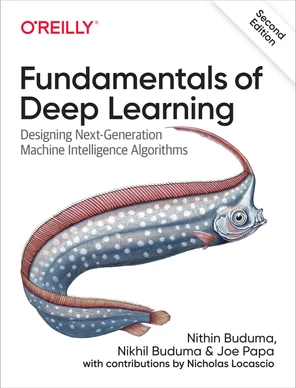
کتاب اصول یادگیری عمیق، ویرایش دوم
ما در میانه انفجار تحقیقات هوش مصنوعی (AI) قرار داریم. یادگیری عمیق (Deep Learning) ادراک ابرانسانی را برای پیشبرد اهدافی مانند خودروهای خودران، شکست دادن متخصصان انسانی در بازیهای پیچیده و تولید متون منسجم ممکن کرده است. با این حال، رمزگشایی از این پیشرفتها اغلب نیازمند مدرک دکترا در یادگیری ماشین و ریاضیات است. ویرایش دوم این کتاب، شهود پشت این نوآوریها را بدون پیچیدگی یا اصطلاحات دشوار شرح میدهد. برنامهنویسان مسلط به پایتون، متخصصان مهندسی نرمافزار و دانشجویان علوم کامپیوتر قادر خواهند بود این پیشرفتها را خودشان پیادهسازی کرده و با سطحی از پیچیدگی که با بهترین توسعهدهندگان این حوزه رقابت میکند، درباره آنها استدلال کنند.
اشتراکی
فصل های کتاب
با مرور فصلها، ساختار ، محتوای کتاب را به سرعت بشناسید.
با مرور فصلهای این کتاب میتونی خیلی سریع بفهمی هر بخش چی یاد میده، ساختار کلی چطوره و از کجا باید شروع کنی. هر فصل روی یک مفهوم یا مهارت خاص تمرکز داره و موضوعات اصلیش رو میبینی تا انتخابت آگاهانهتر باشه. چه بخوای کل کتاب رو دنبال کنی، چه فقط یک بخش خاص رو دنبال کنی، این نما کمکت میکنه مسیرت رو پیدا کنی.
مبانی جبر خطی برای یادگیری عمیق
Data Structures and Operations • Matrix Operations • Vector Operations • Matrix-Vector Multiplication • The Fundamental Spaces • The Column Space • The Null Space • Eigenvectors and Eigenvalues • Summary
درحال تولید...
مبانی احتمال
Events and Probability • Conditional Probability • Random Variables • Expectation • Variance • Bayes’ Theorem • Entropy, Cross Entropy, and KL Divergence • Continuous Probability Distributions • Summary
درحال تولید...
شبکه عصبی
Building Intelligent Machines • The Limits of Traditional Computer Programs • The Mechanics of Machine Learning • The Neuron • Expressing Linear Perceptrons as Neurons • Feed-Forward Neural Networks • Linear Neurons and Their Limitations • Sigmoid, Tanh, and ReLU Neurons • Softmax Output Layers • Summary
درحال تولید...
آموزش شبکههای عصبی پیشخور
The Fast-Food Problem • Gradient Descent • The Delta Rule and Learning Rates • Gradient Descent with Sigmoidal Neurons • The Backpropagation Algorithm • Stochastic and Minibatch Gradient Descent • Test Sets, Validation Sets, and Overfitting • Preventing Overfitting in Deep Neural Networks • Summary
درحال تولید...
پیادهسازی شبکههای عصبی در PyTorch
Introduction to PyTorch • Installing PyTorch • PyTorch Tensors • Tensor Init • Tensor Attributes • Tensor Operations • Gradients in PyTorch • The PyTorch nn Module • PyTorch Datasets and Dataloaders • Building the MNIST Classifier in PyTorch • Summary
درحال تولید...
فراتر از گرادیان کاهشی
The Challenges with Gradient Descent • Local Minima in the Error Surfaces of Deep Networks • Model Identifiability • How Pesky Are Spurious Local Minima in Deep Networks? • Flat Regions in the Error Surface • When the Gradient Points in the Wrong Direction • Momentum-Based Optimization • A Brief View of Second-Order Methods • Learning Rate Adaptation • AdaGrad—Accumulating Historical Gradients • RMSProp—Exponentially Weighted Moving Average of Gradients • Adam—Combining Momentum and RMSProp • The Philosophy Behind Optimizer Selection • Summary
درحال تولید...
شبکههای عصبی کانولوشنی
Neurons in Human Vision • The Shortcomings of Feature Selection • Vanilla Deep Neural Networks Don’t Scale • Filters and Feature Maps • Full Description of the Convolutional Layer • Max Pooling • Full Architectural Description of Convolution Networks • Closing the Loop on MNIST with Convolutional Networks • Image Preprocessing Pipelines Enable More Robust Models • Accelerating Training with Batch Normalization • Group Normalization for Memory Constrained Learning Tasks • Building a Convolutional Network for CIFAR-10 • Visualizing Learning in Convolutional Networks • Residual Learning and Skip Connections for Very Deep Networks • Building a Residual Network with Superhuman Vision • Leveraging Convolutional Filters to Replicate Artistic Styles • Learning Convolutional Filters for Other Problem Domains • Summary
درحال تولید...
یادگیری تعبیه و بازنمایی
Learning Lower-Dimensional Representations • Principal Component Analysis • Motivating the Autoencoder Architecture • Implementing an Autoencoder in PyTorch • Denoising to Force Robust Representations • Sparsity in Autoencoders • When Context Is More Informative than the Input Vector • The Word2Vec Framework • Implementing the Skip-Gram Architecture • Summary
درحال تولید...
مدلهایی برای تحلیل توالی
Analyzing Variable-Length Inputs • Tackling seq2seq with Neural N-Grams • Implementing a Part-of-Speech Tagger • Dependency Parsing and SyntaxNet • Beam Search and Global Normalization • A Case for Stateful Deep Learning Models • Recurrent Neural Networks • The Challenges with Vanishing Gradients • Long Short-Term Memory Units • PyTorch Primitives for RNN Models • Implementing a Sentiment Analysis Model • Solving seq2seq Tasks with Recurrent Neural Networks • Augmenting Recurrent Networks with Attention • Dissecting a Neural Translation Network • Self-Attention and Transformers • Summary
درحال تولید...
مدلهای مولد
Generative Adversarial Networks • Variational Autoencoders • Implementing a VAE • Score-Based Generative Models • Denoising Autoencoders and Score Matching • Summary
درحال تولید...
روشهای تفسیرپذیری
Overview • Decision Trees and Tree-Based Algorithms • Linear Regression • Methods for Evaluating Feature Importance • Permutation Feature Importance • Partial Dependence Plots • Extractive Rationalization • LIME • SHAP • Summary
درحال تولید...
شبکههای عصبی تقویتشده با حافظه
Neural Turing Machines • Attention-Based Memory Access • NTM Memory Addressing Mechanisms • Differentiable Neural Computers • Interference-Free Writing in DNCs • DNC Memory Reuse • Temporal Linking of DNC Writes • Understanding the DNC Read Head • The DNC Controller Network • Visualizing the DNC in Action • Implementing the DNC in PyTorch • Teaching a DNC to Read and Comprehend • Summary
درحال تولید...
یادگیری تقویتی عمیق
Deep Reinforcement Learning Masters Atari Games • What Is Reinforcement Learning? • Markov Decision Processes • Policy • Future Return • Discounted Future Return • Explore Versus Exploit • ϵ -Greedy • Annealed ϵ -Greedy • Policy Versus Value Learning • Pole-Cart with Policy Gradients • OpenAI Gym • Creating an Agent • Building the Model and Optimizer • Sampling Actions • Keeping Track of History • Policy Gradient Main Function • PGAgent Performance on Pole-Cart • Trust-Region Policy Optimization • Proximal Policy Optimization • Q-Learning and Deep Q-Networks • The Bellman Equation • Issues with Value Iteration • Approximating the Q-Function • Deep Q-Network • Training DQN • Learning Stability • Target Q-Network • Experience Replay • From Q-Function to Policy • DQN and the Markov Assumption • DQN’s Solution to the Markov Assumption • Playing Breakout with DQN • Building Our Architecture • Stacking Frames • Setting Up Training Operations • Updating Our Target Q-Network • Implementing Experience Replay • DQN Main Loop • DQNAgent Results on Breakout • Improving and Moving Beyond DQN • Deep Recurrent Q-Networks • Asynchronous Advantage Actor-Critic Agent • UNsupervised REinforcement and Auxiliary Learning • Summary
درحال تولید...
13 فصل در حال تولید
مدت زمان خوانش
11:47
نوع کتاب
اشتراکی
شرکت کنندگان
0 نفر
تولید کتاب
۳۱ شهریور ۱۴۰۵