

Book AI Engineering
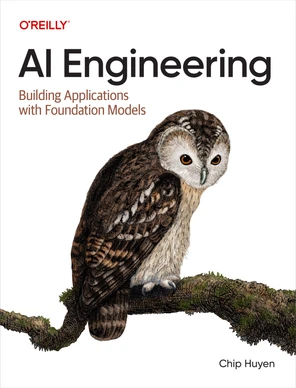
Recent breakthroughs in AI have not only increased demand for AI products, they've also lowered the barriers to entry for those who want to build AI products. The model-as-a-service approach has transformed AI from an esoteric discipline into a powerful development tool that anyone can use. Everyone, including those with minimal or no prior AI experience, can now leverage AI models to build applications. In this book, author Chip Huyen discusses AI engineering: the process of building applications with readily available foundation models. The book starts with an overview of AI engineering, explaining how it differs from traditional ML engineering and discussing the new AI stack. The more AI is used, the more opportunities there are for catastrophic failures, and therefore, the more important evaluation becomes. This book discusses different approaches to evaluating open-ended models, including the rapidly growing AI-as-a-judge approach. AI application developers will discover how to navigate the AI landscape, including models, datasets, evaluation benchmarks, and the seemingly infinite number of use cases and application patterns. You'll learn a framework for developing an AI application, starting with simple techniques and progressing toward more sophisticated methods, and discover how to efficiently deploy these applications. * Understand what AI engineering is and how it differs from traditional machine learning engineering * Learn the process for developing an AI application, the challenges at each step, and approaches to address them * Explore various model adaptation techniques, including prompt engineering, RAG, fine-tuning, agents, and dataset engineering, and understand how and why they work * Examine the bottlenecks for latency and cost when serving foundation models and learn how to overcome them * Choose the right model, dataset, evaluation benchmarks, and metrics for your needs Chip Huyen works to accelerate data analytics on GPUs at Voltron Data. Previously, she was with Snorkel AI and NVIDIA, founded an AI infrastructure startup, and taught Machine Learning Systems Design at Stanford. She's the author of the book Designing Machine Learning Systems, an Amazon bestseller in AI. AI Engineering builds upon and is complementary to Designing Machine Learning Systems (O'Reilly).
Book preface
Before you start, a short look at what you will learn in this book
In the preface, settle the general questions you have at a glance, so your view widens and your choice is more informed. Questions such as: Why was this book written and what problem does it solve? Who can use the book? A summary of the chapters and the learning goals of each part? The important changes and new improvements added across editions, and so on — we cover all of these for you.
Target audience
This book is ideal for AI application developers who want to leverage foundation models to build robust applications. It caters to those with minimal or no prior AI experience, providing a clear path to understanding and implementing modern AI solutions. The content guides users through navigating the complex AI landscape.
Machine learning engineers transitioning to AI engineering will find this book particularly useful. It highlights the differences between traditional ML engineering and the new AI stack, helping them adapt their skills. The book offers insights into the unique challenges and approaches required for working with foundation models.
Professionals interested in optimizing AI inference and deploying AI applications efficiently will benefit from the detailed discussions on latency and cost bottlenecks. The book provides practical strategies for overcoming these challenges, ensuring high-performance and cost-effective deployments. It covers various model optimization and inference service optimization techniques.
Anyone involved in data curation, data augmentation, or dataset engineering for AI models will find valuable guidance. The book covers techniques for improving data quality, coverage, and quantity, including AI-powered data synthesis. It also addresses data processing steps like inspection, deduplication, cleaning, and formatting.
Why the book was written
This book addresses the growing demand for AI products by lowering the entry barriers for developers. It focuses on building applications using readily available foundation models, making advanced AI accessible to a broader audience. The content is designed to bridge the gap between theoretical AI knowledge and practical application development.
It provides a comprehensive overview of AI engineering, differentiating it from traditional ML engineering and introducing the new AI stack. This foundational understanding is crucial for anyone looking to navigate the complexities of modern AI development. The book sets clear expectations for planning, milestones, and maintenance of AI applications.
The book emphasizes the critical importance of evaluation in AI systems, especially for open-ended models, due to the potential for catastrophic failures. It explores various evaluation methodologies, including the innovative AI-as-a-judge approach. This focus ensures developers can build robust and reliable AI applications.
It equips developers with practical model adaptation techniques such as prompt engineering, RAG, fine-tuning, and agents. These techniques are essential for customizing foundation models to specific use cases and optimizing their performance. The book also covers dataset engineering to further enhance model effectiveness.
Content overview
This book effectively demystifies AI engineering, presenting it as a practical discipline for building applications with foundation models. It offers a clear, structured framework for development, making complex concepts accessible to a wide audience. The comprehensive coverage ensures readers gain a solid understanding of the entire AI application lifecycle.
The author provides a valuable distinction between AI engineering and traditional ML engineering, highlighting the unique aspects of the new AI stack. This perspective helps practitioners understand the shift in paradigms and adapt their skills accordingly. The book's insights into evaluation methodologies are particularly strong, addressing a critical need in the field.
The book excels in detailing various model adaptation techniques, from prompt engineering to fine-tuning and RAG. It provides practical guidance on how these methods work and when to apply them, empowering developers to customize foundation models effectively. The inclusion of agents and dataset engineering further enhances its practical utility.
A significant strength of this work is its focus on inference optimization and AI engineering architecture. It addresses crucial concerns like latency and cost when serving foundation models, offering solutions for efficient deployment. The discussions on monitoring, observability, and user feedback provide a holistic view of maintaining AI systems in production.
Published
Reading time
15:52
Book type
Subscription
Participants
2 readers
Last updated
Oct 10, 2026