

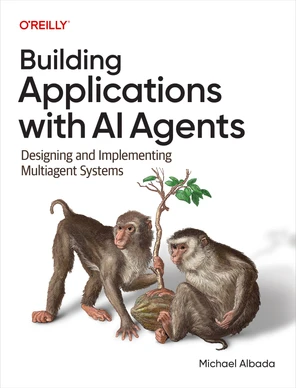
Book Building Applications with AI Agents
Generative AI has revolutionized how organizations tackle problems, accelerating the journey from concept to prototype to solution. As the models become increasingly capable, we have witnessed a new design pattern emerge: AI agents. This book is your indispensable guide through this intricate and fast-moving landscape. Author Michael Albada provides a practical and research-based approach to designing and implementing single- and multiagent systems. It simplifies the complexities and equips you with the tools to move from concept to solution efficiently.
Book preface
Before you start, a short look at what you will learn in this book
In the preface, settle the general questions you have at a glance, so your view widens and your choice is more informed. Questions such as: Why was this book written and what problem does it solve? Who can use the book? A summary of the chapters and the learning goals of each part? The important changes and new improvements added across editions, and so on — we cover all of these for you.
Target audience
Software developers looking to learn how to build intelligent systems. This book is ideal for those who want to go beyond language models and build autonomous agents.
System architects responsible for designing AI infrastructure in organizations. By reading the book, they can make better decisions regarding framework and architecture selection.
Data and machine learning professionals who want to update their knowledge in the field of agents. This book helps them understand advanced concepts like memory and learning in agents.
Technical managers and AI team leads who need a strategic understanding of agent capabilities and limitations. This book assists them in planning AI projects.
Why the book was written
This book addresses the gap in educational resources for designing agent-based systems. With the rapid growth of technology, the need for practical guidance on deploying agents is more felt than ever.
The book's content is compiled based on up-to-date research and practical experiences. This approach helps readers move from theoretical concepts toward practical implementations.
The book explores real-world challenges such as scalability and reliability. These are critical for organizations planning to deploy AI at scale.
As a comprehensive guide, this work covers all aspects of the agent lifecycle. From initial design to production monitoring, all stages are explained in detail.
Content overview
The book manages the complexities of agent design well with a structured approach. The reader is introduced to new challenges in each chapter and receives practical solutions for them.
The author's emphasis on evaluation and monitoring distinguishes this book from other resources. This is highly valuable for those intending to bring their projects to the operational stage.
Comprehensive coverage of popular frameworks like LangGraph and AutoGen makes the book a practical reference. These sections allow the reader to start coding immediately.
The book strikes a good balance between theoretical discussions and technical implementations. This feature makes the content understandable and usable for a wide range of professionals.
Published
Reading time
10:47
Book type
Subscription
Participants
Be the first
Last updated
Nov 16, 2026