

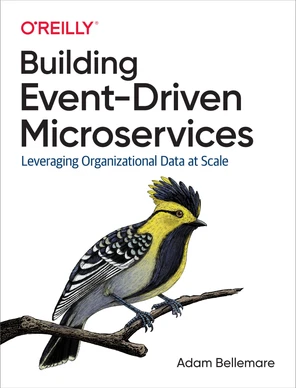
Book Building Event-Driven Microservices
Organizations today often struggle to balance business requirements with ever-increasing volumes of data. Additionally, the demand for leveraging large-scale, real-time data is growing rapidly among the most competitive digital industries. Conventional system architectures may not be up to the task. With this practical guide, you’ll learn how to leverage large-scale data usage across the business units in your organization using the principles of event-driven microservices. Author Adam Bellemare takes you through the process of building an event-driven microservice-powered organization. You’ll reconsider how data is produced, accessed, and propagated across your organization. Learn powerful yet simple patterns for unlocking the value of this data. Incorporate event-driven design and architectural principles into your own systems. And completely rethink how your organization delivers value by unlocking near-real-time access to data at scale. You’ll learn: How to leverage event-driven architectures to deliver exceptional business value The role of microservices in supporting event-driven designs Architectural patterns to ensure success both within and between teams in your organization Application patterns for developing powerful event-driven microservices Components and tooling required to get your microservice ecosystem off the ground
Book preface
Before you start, a short look at what you will learn in this book
In the preface, settle the general questions you have at a glance, so your view widens and your choice is more informed. Questions such as: Why was this book written and what problem does it solve? Who can use the book? A summary of the chapters and the learning goals of each part? The important changes and new improvements added across editions, and so on — we cover all of these for you.
Target audience
Software architects and engineers involved in designing and building scalable, data-intensive systems will find this book highly relevant. It offers guidance on moving beyond traditional architectures to embrace event-driven approaches. The content is suitable for those looking to implement microservices effectively.
Technical leaders and managers responsible for strategic technical decisions and team organization can benefit from understanding event-driven microservice principles. The book discusses communication structures and architectural patterns that impact team success. It helps in rethinking how value is delivered across business units.
Developers working with high volumes of real-time data and seeking more efficient processing methods are a key audience. The book covers application patterns, components, and tooling for building powerful event-driven microservices. It provides practical techniques for materializing state and handling event streams.
Organizations struggling with the limitations of conventional architectures in managing growing data demands will find solutions here. The book offers a blueprint for transforming an organization to be event-driven. It helps in leveraging data more effectively across different business units.
Why the book was written
Many organizations struggle with balancing business needs against increasing data volumes and the demand for real-time data. This book offers a solution by introducing event-driven microservices as a way to overcome limitations of conventional architectures. It provides a practical guide to leveraging large-scale data usage across an organization.
The book aims to help readers reconsider how data is produced, accessed, and propagated within their organizations. It introduces powerful, yet simple, patterns to unlock the value of this data. This shift in perspective is crucial for modern digital industries.
It provides a clear path for incorporating event-driven design and architectural principles into existing or new systems. This allows organizations to build more responsive and scalable solutions. The focus is on practical application and tangible benefits.
Ultimately, the book's purpose is to help organizations deliver value more effectively by enabling near-real-time access to data at scale. It covers the architectural and application patterns necessary for this transformation. This leads to improved business communication and data utilization.
Content overview
This guide provides a practical approach to building an event-driven microservice-powered organization. It helps readers understand how to balance business requirements with increasing data volumes. The book offers powerful patterns for unlocking the value of large-scale, real-time data.
The book effectively demonstrates the role of microservices in supporting event-driven designs. It covers essential architectural and application patterns for successful implementation. Readers will learn how to incorporate these principles into their own systems.
It offers a comprehensive look at the components and tooling required to establish a microservice ecosystem. The content helps organizations rethink how they deliver value by enabling near-real-time data access. It is a valuable resource for those looking to transform their data strategy.
The author guides readers through the process of reconsidering data production, access, and propagation. It addresses the challenges of conventional system architectures in competitive digital industries. The book is well-structured, covering fundamentals, integration, processing, and deployment of event-driven microservices.
Published
Reading time
09:10
Book type
Subscription
Participants
1 readers
Last updated
Nov 16, 2026