

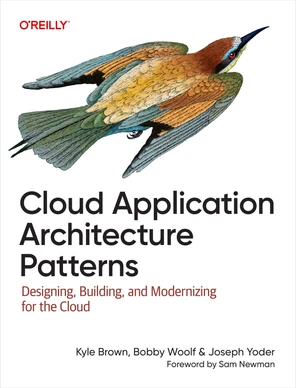
Book Cloud Application Architecture Patterns
There are more applications running in the cloud than there are ones that run well there. If you're considering taking advantage of cloud technology for your company's projects, this practical guide is an ideal way to understand the best practices that will help you architect applications that work well in the cloud, no matter which vendors, products, or languages you use. Architects and lead developers will learn how cloud applications should be designed, how they fit into a larger architectural picture, and how to make them operate efficiently. Authors Kyle Brown, Bobby Woolf, and Joseph Yoder take you through the process step-by-step. Explore proven architectural practices for developing applications for the cloud Understand why some architectural choices are better suited than others for applications intended to run on the cloud Learn design and implementation techniques for developing cloud applications Select the most appropriate cloud adoption patterns for your organization See how all potential choices in application design relate to each other through the connections of the patterns Chart your own course in adopting the right strategies for developing application architectures for the cloud
Book overview
A look at the structure and key facts of the book

Publication date
April 15, 2025

Edition
1 edition

Total chapters
10 chapters

Total pages
650 pages
Level
Intermediate to advanced

There are more applications running in the cloud than there are ones that run well there. If you're considering taking advantage of cloud technology for your company's projects, this practical guide is an ideal way to understand the best practices that will help you architect applications that work well in the cloud, no matter which vendors, products, or languages you use.
Architects and lead developers will learn how cloud applications should be designed, how they fit into a larger architectural picture, and how to make them operate efficiently. Authors Kyle Brown, Bobby Woolf, and Joseph Yoder take you through the process step-by-step.
- Explore proven architectural practices for developing applications for the cloud
- Understand why some architectural choices are better suited than others for applications intended to run on the cloud
- Learn design and implementation techniques for developing cloud applications
- Select the most appropriate cloud adoption patterns for your organization
- See how all potential choices in application design relate to each other through the connections of the patterns
- Chart your own course in adopting the right strategies for developing application architectures for the cloud
Browse this section to get a quick overall picture of the book's content.
Cloud Application Architecture Best Practices
This book focuses on understanding and applying proven architectural practices for developing applications that perform well in the cloud environment. It guides readers through designing, implementing, and operating cloud applications efficiently, highlighting why certain architectural choices are more suitable for cloud environments.
The goal is to help architects and lead developers build applications that not only run in the cloud but also leverage its capabilities optimally. This involves exploring design patterns and strategic decisions to optimize performance and scalability.
Cloud-Native and Microservices Design
This guide delves into the specifics of cloud-native applications, including the Twelve-Factor App principles, and explores microservices architecture in detail. This includes understanding the differences between microservices and monolithic architectures, designing individual microservices, and implementing event-driven architectures for better decoupling and scalability.
Readers learn how to design small, independent components that can be developed, deployed, and scaled independently. This section focuses on patterns and techniques essential for building distributed and resilient systems in the cloud.
Data Storage and Client Interaction in the Cloud
The book examines data storage strategies in cloud-native applications, discussing various database topologies and suitable selections like relational, document, and key-value databases. It also covers designing multimodal user interfaces and client applications, including single-page applications and mobile apps.
This section ensures that user interactions with cloud applications are optimized and efficient. By exploring storage options and client design, readers can create comprehensive solutions for their data and user interface needs.
Application Migration and Modernization
A significant theme in this guide is the process of migrating existing applications to the cloud and modernizing them. This involves exploring different cloud migration strategies such as lift and shift, containerization, and refactoring monoliths. It also discusses specific patterns like the Strangler Fig pattern to incrementally transform legacy systems into cloud-native solutions.
This section helps organizations effectively move their legacy applications to the cloud and modernize them to leverage cloud benefits. These guidelines are crucial for mitigating risks and enhancing efficiency in the digital transformation process.
The authors behind this book are among the most prominent experts and pioneers of their field. Their work is the result of years of hands-on experience, deep research and collaboration with the world's largest technology organizations and companies.Each of these authors, through specialist books and articles, has played an important role in shaping and advancing technical knowledge worldwide.



Comments
Readers' experience with this book - comments from buyers and other users
10 chapters in production
Reading time
20:07
Book type
Subscription
Participants
Be the first
Last updated
Sep 30, 2026