

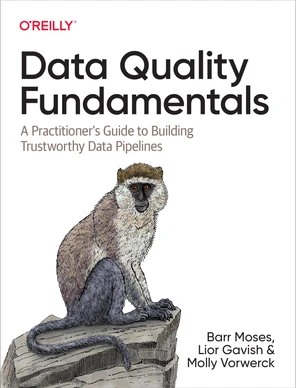
Book Data Quality Fundamentals
Do your product dashboards look funky? Are your quarterly reports stale? Is the data set you're using broken or just plain wrong? These problems affect almost every team, yet they're usually addressed on an ad hoc basis and in a reactive manner. Many data engineering teams today face the "good pipelines, bad data" problem. It doesn't matter how advanced your data infrastructure is if the data you're piping is bad. In this book, Barr Moses, Lior Gavish, and Molly Vorwerck, from the data observability company Monte Carlo, explain how to tackle data quality and trust at scale by leveraging best practices and technologies used by some of the world's most innovative companies.
Book preface
Before you start, a short look at what you will learn in this book
In the preface, settle the general questions you have at a glance, so your view widens and your choice is more informed. Questions such as: Why was this book written and what problem does it solve? Who can use the book? A summary of the chapters and the learning goals of each part? The important changes and new improvements added across editions, and so on — we cover all of these for you.
Target audience
Data engineers looking to improve the stability of their pipelines. The book introduces necessary tools for data monitoring and testing.
Data product managers who want to increase user trust in dashboards and reports. The book helps them define quality metrics.
Data analysts who face invalid data and incorrect reports. The book helps them identify and resolve the root causes of these issues.
Data team leaders planning to implement data governance in their organization. The book provides scaling strategies for growing teams.
Why the book was written
The book addresses common data engineering challenges like broken pipelines. The authors provide practical solutions to improve system reliability.
Complex concepts of data observability are explained in simple terms. This book is highly practical for teams struggling with poor-quality data.
Real-world case studies from leading companies are provided. These help in better understanding how to implement data quality strategies.
The book emphasizes data culture and governance. This approach helps teams think beyond technical tools and manage data as a product.
Content overview
This book is a comprehensive guide to understanding and managing data quality in the modern world. The authors provide a clear roadmap by combining technical knowledge and organizational strategies.
The focus on data observability distinguishes this work from other similar books. The use of case studies makes abstract concepts tangible.
The book effectively demonstrates that data quality is not just a technical issue. The authors correctly emphasize the importance of organizational culture and accountability.
Reading this book is essential for any team that cares about their data. The provided solutions for scaling and automation are highly valuable.
10 chapters in production
Reading time
08:43
Book type
Subscription
Participants
Be the first
Last updated
Sep 30, 2026