

Book Database Internals
When it comes to choosing, using, and maintaining a database, understanding its internals is essential. But with so many distributed databases and tools available today, it’s often difficult to understand what each one offers and how they differ. With this practical guide, Alex Petrov guides developers through the concepts behind modern database and storage engine internals. Throughout the book, you’ll explore relevant material gleaned from numerous books, papers, blog posts, and the source code of several open source databases. These resources are listed at the end of parts one and two. You’ll discover that the most significant distinctions among many modern databases reside in subsystems that determine how storage is organized and how data is distributed. This book examines: Storage engines: Explore storage classification and taxonomy, and dive into B-Tree-based and immutable Log Structured storage engines, with differences and use-cases for each Storage building blocks: Learn how database files are organized to build efficient storage, using auxiliary data structures such as Page Cache, Buffer Pool and Write-Ahead Log Distributed systems: Learn step-by-step how nodes and processes connect and build complex communication patterns Database clusters: Which consistency models are commonly used by modern databases and how distributed storage systems achieve consistency
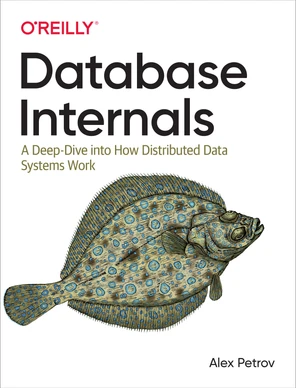
Book overview
A look at the structure and key facts of the book

Publication date
October 2, 2019

Edition
1 edition

Total chapters
14 chapters

Total pages
370 pages
Level
Intermediate to advanced

When it comes to choosing, using, and maintaining a database, understanding its internals is essential. But with so many distributed databases and tools available today, it’s often difficult to understand what each one offers and how they differ. With this practical guide, Alex Petrov guides developers through the concepts behind modern database and storage engine internals.
Throughout the book, you’ll explore relevant material gleaned from numerous books, papers, blog posts, and the source code of several open source databases. These resources are listed at the end of parts one and two. You’ll discover that the most significant distinctions among many modern databases reside in subsystems that determine how storage is organized and how data is distributed.
This book examines: Storage engines: Explore storage classification and taxonomy, and dive into B-Tree-based and immutable Log Structured storage engines, with differences and use-cases for each Storage building blocks: Learn how database files are organized to build efficient storage, using auxiliary data structures such as Page Cache, Buffer Pool and Write-Ahead Log Distributed systems: Learn step-by-step how nodes and processes connect and build complex communication patterns Database clusters: Which consistency models are commonly used by modern databases and how distributed storage systems achieve consistency
Browse this section to get a quick overall picture of the book's content.
Storage Engines
This section delves into the fundamental concepts of storage engines, exploring their classification and taxonomy. It provides a detailed examination of both B-Tree-based and immutable Log Structured storage engines, highlighting their architectural differences. Readers will understand the specific use-cases and performance characteristics that make each type suitable for various database workloads, enabling informed decisions for system design.
Storage Building Blocks
This part focuses on the foundational components that enable efficient data storage within databases. It explains how database files are structured and managed to optimize read and write operations. Key auxiliary data structures, including the Page Cache, Buffer Pool, and Write-Ahead Log (WAL), are explored in detail, demonstrating their roles in performance, durability, and recovery mechanisms.
Distributed Systems
This section introduces the core principles of distributed systems, detailing how individual nodes and processes interact across a network. It covers the essential mechanisms for establishing connections and managing communication patterns in a distributed environment. Readers will gain an understanding of the challenges and solutions involved in building robust and scalable systems where components operate independently yet cooperatively.
Database Clusters
This part explores the critical aspects of database clusters, focusing on the various consistency models employed by modern distributed databases. It explains how these models, such as eventual consistency or strong consistency, impact data integrity and availability across multiple nodes. The book details the underlying mechanisms and algorithms that distributed storage systems utilize to achieve and maintain data consistency, even in the face of failures and network partitions.
The authors behind this book are among the most prominent experts and pioneers of their field. Their work is the result of years of hands-on experience, deep research and collaboration with the world's largest technology organizations and companies.Each of these authors, through specialist books and articles, has played an important role in shaping and advancing technical knowledge worldwide.

Comments
Readers' experience with this book - comments from buyers and other users
14 chapters in production
Reading time
10:23
Book type
Subscription
Participants
Be the first
Last updated
Oct 1, 2026