

Book Designing Data-Intensive Applications, 2nd Edition
Data is at the center of many challenges in system design today. Difficult issues such as scalability, consistency, reliability, efficiency, and maintainability need to be resolved. In addition, there's an overwhelming variety of systems, including relational databases, NoSQL datastores, data warehouses, and data lakes. There are cloud services, on-premises services, and embedded databases. What are the right choices for your application? How do you make sense of all these buzzwords? In this second edition, authors Martin Kleppmann and Chris Riccomini build on the foundation laid in the acclaimed first edition, integrating new technologies and emerging trends. You'll be guided through the maze of decisions and trade-offs involved in building a modern data system, learn how to choose the right tools for your needs, and understand the fundamentals of distributed systems. Peer under the hood of the systems you already use, and learn to use them more effectively Make informed decisions by identifying the strengths and weaknesses of different tools Learn how major cloud services are designed for scalability, fault tolerance, and consistency Understand the core principles upon which modern databases are built
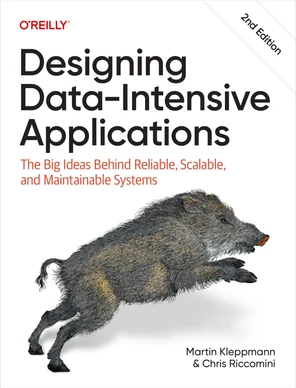
Book overview
A look at the structure and key facts of the book

Publication date
February 18, 2026

Edition
2 edition

Total chapters
14 chapters

Total pages
672 pages

Level
Intermediate to advanced

Data is at the center of many challenges in system design today. Difficult issues such as scalability, consistency, reliability, efficiency, and maintainability need to be resolved. In addition, there's an overwhelming variety of systems, including relational databases, NoSQL datastores, data warehouses, and data lakes. There are cloud services, on-premises services, and embedded databases. What are the right choices for your application? How do you make sense of all these buzzwords?
In this second edition, authors Martin Kleppmann and Chris Riccomini build on the foundation laid in the acclaimed first edition, integrating new technologies and emerging trends. You'll be guided through the maze of decisions and trade-offs involved in building a modern data system, learn how to choose the right tools for your needs, and understand the fundamentals of distributed systems.
- Peer under the hood of the systems you already use, and learn to use them more effectively
- Make informed decisions by identifying the strengths and weaknesses of different tools
- Learn how major cloud services are designed for scalability, fault tolerance, and consistency
- Understand the core principles upon which modern databases are built
Browse this section to get a quick overall picture of the book's content.
Designing Resilient and Scalable Data Systems
This book delves into the critical aspects of building data systems that are both resilient and scalable. It explores how to address complex challenges such as fault tolerance, consistency, and reliability in the face of hardware failures, software bugs, and human errors.
Readers will learn the principles behind designing systems that can handle increasing loads and maintain high availability.
Navigating Diverse Data Storage Technologies
The book provides a comprehensive guide to the overwhelming variety of data storage options available today. It covers the characteristics, strengths, and weaknesses of different systems, including relational databases, NoSQL datastores, data warehouses, and data lakes.
Readers will gain insights into choosing the appropriate tools for specific application needs and understanding their underlying architectures.
Making Informed Architectural Decisions
This edition guides readers through the intricate process of making informed architectural decisions for modern data systems. It emphasizes understanding the trade-offs involved in various design choices, from cloud versus self-hosting to distributed versus single-node systems.
The content helps practitioners evaluate different tools and approaches based on nonfunctional requirements like performance, scalability, and maintainability.
The authors behind this book are among the most prominent experts and pioneers of their field. Their work is the result of years of hands-on experience, deep research and collaboration with the world's largest technology organizations and companies.Each of these authors, through specialist books and articles, has played an important role in shaping and advancing technical knowledge worldwide.


Comments
Readers' experience with this book - comments from buyers and other users
14 chapters in production
Reading time
21:56
Book type
Subscription
Participants
Be the first
Last updated
Oct 10, 2026