

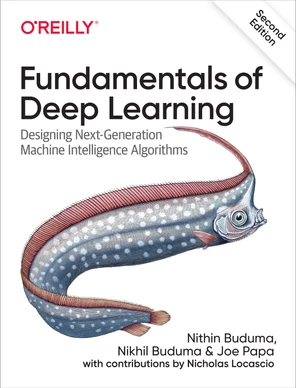
Book Fundamentals of Deep Learning, 2nd Edition
We're in the midst of an AI research explosion. Deep learning has unlocked superhuman perception to power our push toward creating self-driving vehicles, defeating human experts at a variety of difficult games including Go, and even generating essays with shockingly coherent prose. But deciphering these breakthroughs often takes a PhD in machine learning and mathematics. The updated second edition of this book describes the intuition behind these innovations without jargon or complexity. Python-proficient programmers, software engineering professionals, and computer science majors will be able to reimplement these breakthroughs on their own and reason about them with a level of sophistication that rivals some of the best developers in the field.
Book preface
Before you start, a short look at what you will learn in this book
In the preface, settle the general questions you have at a glance, so your view widens and your choice is more informed. Questions such as: Why was this book written and what problem does it solve? Who can use the book? A summary of the chapters and the learning goals of each part? The important changes and new improvements added across editions, and so on — we cover all of these for you.
Target audience
Python-proficient programmers looking to enter the field of deep learning. These individuals are familiar with coding concepts and now want to extend their knowledge to AI models.
Software engineering professionals who want to apply deep learning techniques in their projects. This book helps them handle model complexities in a professional manner.
Computer science students looking for a deeper understanding of mathematical foundations and neural network mechanics. This book serves as a resource to strengthen their analytical skills.
AI researchers who need a reference to review basic and advanced concepts. By providing intuitive explanations, this book helps solidify their knowledge across various domains.
Why the book was written
This book addresses the gap between complex academic theories and practical deep learning applications. It aims to provide the intuition necessary to understand modern innovations without getting bogged down in unnecessary technical jargon.
By using modern libraries like PyTorch, readers can implement advanced models from scratch. This approach focuses on understanding underlying mechanisms rather than relying on abstraction.
The second edition includes extensive coverage of new topics including generative models and interpretability methods. This update was necessary to keep pace with the rapid speed of AI advancements.
This book is designed as a comprehensive guide for software engineers and data scientists. Its content is structured to be suitable for both theoretical learning and practical applications in work environments.
Content overview
The book successfully translates difficult deep learning concepts into simple and understandable language. By focusing on mathematical intuition, the authors make learning enjoyable for the reader.
The book's practical approach using PyTorch distinguishes it from other theoretical resources. Readers can experience practical implementations immediately after reading each chapter.
The comprehensive coverage of topics from linear algebra to reinforcement learning makes this work an excellent reference source. The book's structure guides the reader step-by-step toward mastery.
The second edition, with its precise updates, well addresses the needs of the modern AI community. This book is essential for anyone who wants to be a leader in this field.
13 chapters in production
Reading time
11:47
Book type
Subscription
Participants
Be the first
Last updated
Sep 30, 2026