

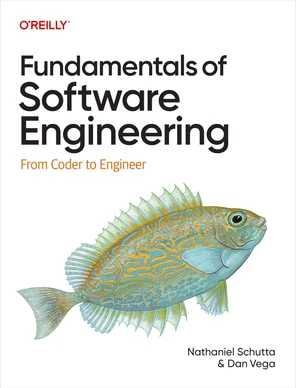
Book Fundamentals of Software Engineering
What do you need to know to be a successful software engineer? Undergraduate curricula and bootcamps may teach the fundamentals of algorithms and writing code, but they rarely cover topics vital to your career advancement. With this practical book, you'll learn the skills you need to succeed and thrive. Authors Nathaniel Schutta and Dan Vega guide your journey with everything from pointers to deep dives into specific topic areas that will help you build the skills that really matter as a software engineer. Understand what software engineering is—and why communication and other soft skills matter Learn the basics of software architecture and architectural drivers Use common and proven techniques to read and refactor code bases Understand the importance of testing and how to implement an effective test suite Learn how to reliably and repeatedly deploy software Know how to evaluate and choose the right solution or tool for a given problem
Book preface
Before you start, a short look at what you will learn in this book
In the preface, settle the general questions you have at a glance, so your view widens and your choice is more informed. Questions such as: Why was this book written and what problem does it solve? Who can use the book? A summary of the chapters and the learning goals of each part? The important changes and new improvements added across editions, and so on — we cover all of these for you.
Target audience
Computer science students and graduates planning to enter the job market.
Junior developers who want to advance from coding to software engineering.
Programmers trained in bootcamp environments looking for a deeper understanding of concepts.
Software engineers looking to improve productivity and learn modern tools like AI.
Why the book was written
The book bridges the gap between academic training and the real-world needs of the profession.
Vital topics like architecture, testing, and deployment, which are often overlooked in training courses, are covered.
This work provides a practical guide for developing soft and communication skills alongside technical knowledge.
The authors use their experience to map out the career advancement path for junior engineers.
Content overview
The book is a comprehensive roadmap for those who want to transition from a programmer to a software engineer.
The excellent balance between technical topics and soft skills makes this work a valuable resource for developers.
The authors' practical approach to covering topics like architecture and testing is highly informative and applicable.
The chapters on AI and career management create added value for today's engineers.
15 chapters in production
Reading time
10:38
Book type
Subscription
Participants
Be the first
Last updated
Sep 30, 2026