

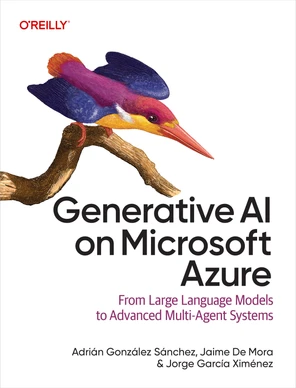
Book Generative AI on Microsoft Azure
Companies are now moving generative AI projects out of the lab and into production environments. To support these increasingly sophisticated applications, they’re turning to advanced practices such as multi-agent architectures and complex code-based frameworks. This practical handbook shows you how to leverage cutting-edge techniques using Microsoft’s powerful ecosystem of tools to deploy trustworthy AI systems tailored to your organization’s needs. Written for and by AI professionals, Generative AI on Microsoft Azure goes beyond the technical core aspects, examining underlying principles, tools, and practices in depth, from the art of prompt engineering to strategies for fine-tuning models to advanced techniques like retrieval-augmented generation (RAG) and agentic AI. Through real-world case studies and insights from top experts, you’ll learn how to harness AI’s full potential on Azure, paving the way for groundbreaking solutions and sustainable success in today’s AI-driven landscape. * Understand the technical foundations of generative AI and how the technology has evolved over the last few years * Implement advanced GenAI applications using services like Microsoft Foundry or Copilot, among others * Leverage patterns, tools, frameworks, and platforms to customize AI projects * Manage, govern, and secure your AI-enabled systems with responsible AI practices * Learn to avoid common pitfalls, future-proof your applications, and more
Book overview
A look at the structure and key facts of the book

Publication date
April 9, 2026

Edition
1 edition

Total chapters
9 chapters

Total pages
322 pages
Level
Intermediate to advanced

Companies are now moving generative AI projects out of the lab and into production environments. To support these increasingly sophisticated applications, they’re turning to advanced practices such as multi-agent architectures and complex code-based frameworks. This practical handbook shows you how to leverage cutting-edge techniques using Microsoft’s powerful ecosystem of tools to deploy trustworthy AI systems tailored to your organization’s needs.
Written for and by AI professionals, Generative AI on Microsoft Azure goes beyond the technical core aspects, examining underlying principles, tools, and practices in depth, from the art of prompt engineering to strategies for fine-tuning models to advanced techniques like retrieval-augmented generation (RAG) and agentic AI. Through real-world case studies and insights from top experts, you’ll learn how to harness AI’s full potential on Azure, paving the way for groundbreaking solutions and sustainable success in today’s AI-driven landscape.
- Understand the technical foundations of generative AI and how the technology has evolved over the last few years
- Implement advanced GenAI applications using services like Microsoft Foundry or Copilot, among others
- Leverage patterns, tools, frameworks, and platforms to customize AI projects
- Manage, govern, and secure your AI-enabled systems with responsible AI practices
- Learn to avoid common pitfalls, future-proof your applications, and more
Browse this section to get a quick overall picture of the book's content.
Technical Foundations of Generative AI
This section delves into the technical foundations of generative AI, outlining the evolution of its adoption patterns over time. Key topics include the types of generative AI models, fundamental technical concepts such as pretraining, post-training, and inference, and how these concepts map to the Microsoft Azure ecosystem. The aim is to provide readers with a comprehensive understanding of the underlying technology and its real-world implementation.
It also examines how the technology has evolved over the last few years, offering insights into emerging trends. Grasping these fundamentals is crucial for AI professionals looking to deploy complex projects on Azure. The chapter concludes with a summary that encapsulates the main takeaways.
Deploying and Customizing AI on Azure
This section focuses on transitioning generative AI projects from prototype to production on Microsoft Azure. It involves exploring Azure's advanced AI ecosystem, with a particular emphasis on Microsoft Foundry and its capabilities for models, workflows, and safety. Model diversity, multi-provider strategies, and the Azure AI Model Catalog are also addressed.
Furthermore, deployment patterns, building agents in Azure, and integration with Microsoft Copilot and Copilot Studio are discussed. A significant portion is dedicated to vector databases, Azure AI Search, and Azure Cosmos DB with Vector Search, which are crucial for managing the data required by modern AI applications. Web application frameworks and integration with GitHub Copilot are also covered to provide a comprehensive understanding of deploying and customizing AI applications on Azure.
Prompt Engineering and Retrieval-Augmented Generation (RAG)
This section covers best practices for model selection and prompt engineering within the Microsoft AI ecosystem. Readers will learn about considerations for choosing models, including utilizing Microsoft Foundry and Azure OpenAI Models. Prompt engineering best practices, including laying the foundation for effective prompts and various techniques, are explained in detail.
A significant part is dedicated to Retrieval-Augmented Generation (RAG), covering its fundamentals, the RAG process, its implementation in Azure using Azure AI Search, and iterative optimization of RAG pipelines. Advanced RAG scenarios such as multimodal RAG, GraphRAG, NL2SQL, and Agentic RAG are also explored to provide a comprehensive understanding of these powerful techniques.
Fine-Tuning Models and Agentic Systems
This section addresses two key areas in generative AI development: fine-tuning models and building agentic systems. First, it discusses the conditions under which fine-tuning models is necessary, comparing it with prompt engineering and RAG. Types of fine-tuning, such as SFT and PEFT, are covered, along with step-by-step processes for fine-tuning Azure OpenAI models and other catalog models in Microsoft Foundry.
Next, the section delves into agentic systems, explaining when to use them, agentic protocols, and agent design patterns like sequential, workflow, concurrent, group-chat, self-reflection, and human-in-the-loop patterns. How to build agentic systems in Azure, including the Microsoft Foundry Agent Service, the Microsoft Agent Framework, and deploying hosted agents, is also covered.
The authors behind this book are among the most prominent experts and pioneers of their field. Their work is the result of years of hands-on experience, deep research and collaboration with the world's largest technology organizations and companies.Each of these authors, through specialist books and articles, has played an important role in shaping and advancing technical knowledge worldwide.



Comments
Readers' experience with this book - comments from buyers and other users
9 chapters in production
Reading time
10:16
Book type
Subscription
Participants
Be the first
Last updated
Sep 30, 2026