

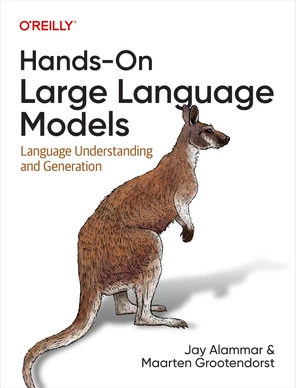
Book Hands-On Large Language Models
AI has acquired startling new language capabilities in just the past few years. Driven by rapid advances in deep learning, language AI systems are able to write and understand text better than ever before. This trend is enabling new features, products, and entire industries. Through this book's visually educational nature, readers will learn practical tools and concepts they need to use these capabilities today. You'll understand how to use pretrained large language models for use cases like copywriting and summarization; create semantic search systems that go beyond keyword matching; and use existing libraries and pretrained models for text classification, search, and clusterings. This book also helps you: Understand the architecture of Transformer language models that excel at text generation and representation; Build advanced LLM pipelines to cluster text documents and explore the topics they cover; Build semantic search engines that go beyond keyword search, using methods like dense retrieval and rerankers; Explore how generative models can be used, from prompt engineering all the way to retrieval-augmented generation; Gain a deeper understanding of how to train LLMs and optimize them for specific applications using generative model fine-tuning, contrastive fine-tuning, and in-context learning.
Book chapters
Browse the chapters to quickly get to know the structure and content of the book.
By browsing the chapters of this book you can quickly see what each part teaches, how the whole is structured and where to start. Each chapter focuses on one concept or skill, and you see its main topics so your choice is more informed. Whether you follow the whole book or just one part, this view helps you find your way.
Part I. Understanding Language Models
This section introduces the core concepts of Large Language Models, starting from their history and the evolution of Natural Language Processing (NLP). It explores how text is represented through tokens and embeddings, and provides a detailed look inside the Transformer architecture. Readers will learn about the mechanics of attention and the differences between various model types.
1. An Introduction to Large Language Models
2. Tokens and Embeddings
3. Looking Inside Large Language Models
Part II. Using Pretrained Language Models
This section focuses on the practical application of pretrained Large Language Models for various tasks. It covers text classification, clustering, and topic modeling using frameworks like BERTopic. Readers will also master prompt engineering and advanced generation techniques, including Retrieval-Augmented Generation (RAG) and multimodal applications with CLIP.
4. Text Classification
5. Text Clustering and Topic Modeling
6. Prompt Engineering
7. Advanced Text Generation Techniques and Tools
8. Semantic Search and Retrieval-Augmented Generation
9. Multimodal Large Language Models
Part III. Training and Fine-Tuning Language Models
This part delves into the training and optimization of Large Language Models. It explains how to create text embedding models using contrastive learning and how to fine-tune representation models for classification. The section concludes with advanced fine-tuning techniques for generative models, including PEFT, QLoRA, and alignment methods like RLHF and DPO.
10. Creating Text Embedding Models
11. Fine-Tuning Representation Models for Classification
12. Fine-Tuning Generation Models
12 chapters in production
Reading time
10:29
Book type
Subscription
Participants
Be the first
Last updated
Sep 30, 2026