

Introduction to Retrieval-Augmented Generation (RAG)
Imagine your most brilliant employee has read every book in the library but has never seen your company’s internal handbook. When asked about specific office policies, they might guess confidently, leading to dangerous misinformation. This is the exact state of modern Large Language Models (LLMs) when they operate in isolation. They possess incredible linguistic fluency but suffer from a critical lack of context regarding your private, evolving data. Retrieval-Augmented Generation (RAG) solves this by acting as a bridge, grounding the model’s creative power in your specific, verified facts. At its core, RAG is a system that fetches relevant information from your private data before asking the LLM to generate an answer. Without this, you face hallucinations—fluent, authoritative-sounding lies. Think of RAG like an open-book exam: instead of relying on memory, the model is given a textbook to reference, ensuring its output is accurate and verifiable. The RAG stack consists of two primary pipelines: the Ingestion Flow, which processes and indexes your documents into a searchable format, and the Query Flow, which retrieves the right snippets to answer a user's prompt. Using frameworks like LangChain, developers can orchestrate these flows to build everything from Virtual Assistants and Question-Answering Systems to complex Enterprise Knowledge Management tools. When comparing RAG to other approaches, the distinction is clear. Unlike Fine-Tuning, which bakes information into the model's weights—making updates slow and expensive—RAG allows for near-instant knowledge updates. You simply add or remove documents from your index. While simple "Chat with PDF" tools are a starting point, Advanced RAG introduces Agentic RAG, Multimodal RAG, and Knowledge Graphs to handle complex reasoning, diverse media, and structured relationships. This architecture provides explainability, as you can trace exactly which documents informed an answer, and enables robust access controls to ensure users only see data they are authorized to view. | Approach | Update Speed | Accuracy | Cost to Maintain | | :--- | :--- | :--- | :--- | | Fine-Tuning | Slow | Variable | High | | RAG | Instant | High | Low | [ ] Implement an ingestion pipeline to chunk and index private data. [ ] Configure a vector search mechanism for the retrieval phase. [ ] Integrate an LLM to synthesize answers based on retrieved context. [ ] Apply access control filters to ensure data security. [ ] Evaluate system performance using retrieval metrics and hallucination checks.
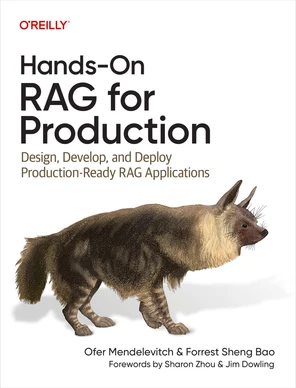
Chapter 1 of Hands-On RAG for Production: Introduction to Retrieval-Augmented Generation (RAG)
About this chapter
Before you start, take a quick look at what this chapter covers
Before you enter the flashcards, read this summary so your mind is ready and you know exactly what to expect. When you know what problem this chapter solves and why it matters, learning is deeper and faster. Here you see which concepts the chapter covers, how it is structured and how it relates to the other chapters. With this mental preparation, flashcards are no longer memorizing — they are understanding. Your brain sees the connections, not just the words.
Imagine your most brilliant employee has read every book in the library but has never seen your company’s internal handbook. When asked about specific office policies, they might guess confidently, leading to dangerous misinformation. This is the exact state of modern Large Language Models (LLMs) when they operate in isolation. They possess incredible linguistic fluency but suffer from a critical lack of context regarding your private, evolving data. Retrieval-Augmented Generation (RAG) solves this by acting as a bridge, grounding the model’s creative power in your specific, verified facts.
At its core, RAG is a system that fetches relevant information from your private data before asking the LLM to generate an answer. Without this, you face hallucinations—fluent, authoritative-sounding lies. Think of RAG like an open-book exam: instead of relying on memory, the model is given a textbook to reference, ensuring its output is accurate and verifiable. The RAG stack consists of two primary pipelines: the Ingestion Flow, which processes and indexes your documents into a searchable format, and the Query Flow, which retrieves the right snippets to answer a user's prompt. Using frameworks like LangChain, developers can orchestrate these flows to build everything from Virtual Assistants and Question-Answering Systems to complex Enterprise Knowledge Management tools.
When comparing RAG to other approaches, the distinction is clear. Unlike Fine-Tuning, which bakes information into the model's weights—making updates slow and expensive—RAG allows for near-instant knowledge updates. You simply add or remove documents from your index. While simple "Chat with PDF" tools are a starting point, Advanced RAG introduces Agentic RAG, Multimodal RAG, and Knowledge Graphs to handle complex reasoning, diverse media, and structured relationships. This architecture provides explainability, as you can trace exactly which documents informed an answer, and enables robust access controls to ensure users only see data they are authorized to view.
| Approach | Update Speed | Accuracy | Cost to Maintain |
|---|---|---|---|
| Fine-Tuning | Slow | Variable | High |
| RAG | Instant | High | Low |
- Implement an ingestion pipeline to chunk and index private data.
- Configure a vector search mechanism for the retrieval phase.
- Integrate an LLM to synthesize answers based on retrieved context.
- Apply access control filters to ensure data security.
- Evaluate system performance using retrieval metrics and hallucination checks.