

The Base RAG Stack
Building a production-grade RAG system requires moving beyond simple API calls to orchestrating a robust data pipeline. You are essentially building a specialized search engine that feeds a reasoning engine, and the quality of your output is strictly bounded by the quality of your data preparation and retrieval strategy. The RAG Pipeline At the heart of every RAG system are two distinct flows: the ingestion flow and the query flow. The ingestion flow acts as your data factory, transforming raw documents into searchable vectors, while the query flow functions as the real-time retrieval mechanism. Without a clear separation, you risk data corruption and inefficient search performance. Think of this like a library: the ingestion flow is the librarian cataloging books and placing them on shelves, while the query flow is the patron searching the index to find the right book. Data Processing and Embeddings Before data hits your database, it must undergo document parsing and text chunking. Parsing extracts meaningful content from varied formats, sometimes even utilizing vision-language models for complex layouts. Once parsed, you must break text into chunks, choosing a strategy that balances context preservation with search precision. These chunks are then converted into embeddings—numerical representations of semantic meaning. Selecting the right embedding model is a critical trade-off between computational cost and retrieval accuracy. If your chunks are too large, you lose specificity; if they are too small, you lose context. Vector Search and Generation Once embedded, your data resides in a vector database, which uses approximate nearest neighbor algorithms to perform high-speed similarity searches. This is where you balance latency against recall. Finally, the generative LLM synthesizes the retrieved context. Prompt engineering here is not just about style; it is about grounding the model to prevent hallucinations. You must continuously evaluate your prompt templates to ensure the model correctly interprets the retrieved data. Key Considerations Latency vs. Accuracy: Complex parsing and reranking improve results but increase response time. Storage vs. Searchability: Dense vector search is powerful but requires careful index tuning. [ ] Implement an asynchronous ingestion pipeline for document processing. [ ] Select chunking strategies based on document structure and query intent. [ ] Evaluate embedding models against your specific domain vocabulary. [ ] Configure vector database parameters for optimal similarity search performance. [ ] Design prompt templates that explicitly handle retrieved context and fallback scenarios.
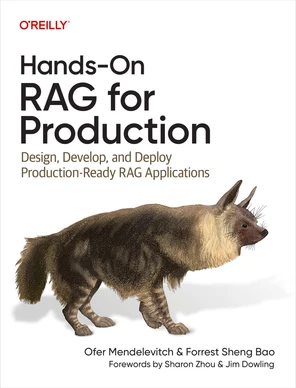
Chapter 2 of Hands-On RAG for Production: The Base RAG Stack
About this chapter
Before you start, take a quick look at what this chapter covers
Before you enter the flashcards, read this summary so your mind is ready and you know exactly what to expect. When you know what problem this chapter solves and why it matters, learning is deeper and faster. Here you see which concepts the chapter covers, how it is structured and how it relates to the other chapters. With this mental preparation, flashcards are no longer memorizing — they are understanding. Your brain sees the connections, not just the words.
Building a production-grade RAG system requires moving beyond simple API calls to orchestrating a robust data pipeline. You are essentially building a specialized search engine that feeds a reasoning engine, and the quality of your output is strictly bounded by the quality of your data preparation and retrieval strategy.
The RAG Pipeline
At the heart of every RAG system are two distinct flows: the ingestion flow and the query flow. The ingestion flow acts as your data factory, transforming raw documents into searchable vectors, while the query flow functions as the real-time retrieval mechanism. Without a clear separation, you risk data corruption and inefficient search performance. Think of this like a library: the ingestion flow is the librarian cataloging books and placing them on shelves, while the query flow is the patron searching the index to find the right book.
Data Processing and Embeddings
Before data hits your database, it must undergo document parsing and text chunking. Parsing extracts meaningful content from varied formats, sometimes even utilizing vision-language models for complex layouts. Once parsed, you must break text into chunks, choosing a strategy that balances context preservation with search precision. These chunks are then converted into embeddings—numerical representations of semantic meaning. Selecting the right embedding model is a critical trade-off between computational cost and retrieval accuracy. If your chunks are too large, you lose specificity; if they are too small, you lose context.
Vector Search and Generation
Once embedded, your data resides in a vector database, which uses approximate nearest neighbor algorithms to perform high-speed similarity searches. This is where you balance latency against recall. Finally, the generative LLM synthesizes the retrieved context. Prompt engineering here is not just about style; it is about grounding the model to prevent hallucinations. You must continuously evaluate your prompt templates to ensure the model correctly interprets the retrieved data.
Key Considerations
-
Latency vs. Accuracy: Complex parsing and reranking improve results but increase response time.
-
Storage vs. Searchability: Dense vector search is powerful but requires careful index tuning.
-
Implement an asynchronous ingestion pipeline for document processing.
-
Select chunking strategies based on document structure and query intent.
-
Evaluate embedding models against your specific domain vocabulary.
-
Configure vector database parameters for optimal similarity search performance.
-
Design prompt templates that explicitly handle retrieved context and fallback scenarios.