

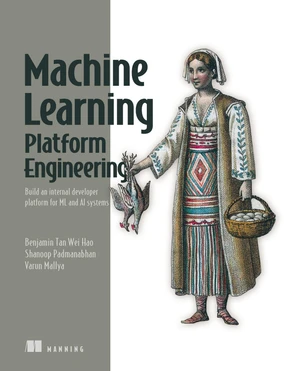
Book Machine Learning Platform Engineering
Get your machine learning models out of the lab and into production! Delivering a successful machine learning project is hard. Machine Learning Platform Engineering makes it easier. In it, you’ll design a reliable ML system from the ground up, incorporating MLOps and DevOps along with a stack of proven infrastructure tools including Kubeflow, MLFlow, BentoML, Evidently, and Feast. A properly designed machine learning system streamlines data workflows, improves collaboration between data and operations teams, and provides much-needed structure for both training and deployment. In Machine Learning Platform Engineering you’ll learn how to design and implement a machine learning system from the ground up. You’ll appreciate this instantly-useful introduction to achieving the full benefits of automated ML infrastructure. AI and ML systems have a lot of moving parts, from language libraries and application frameworks, to workflow and deployment infrastructure, to LLMs and other advanced models. A well-designed internal development platform (IDP) gives developers a defined set of tools and guidelines that accelerate the dev process, improving consistency, security, and developer experience.
Book chapters
Browse the chapters to quickly get to know the structure and content of the book.
By browsing the chapters of this book you can quickly see what each part teaches, how the whole is structured and where to start. Each chapter focuses on one concept or skill, and you see its main topics so your choice is more informed. Whether you follow the whole book or just one part, this view helps you find your way.
Part 1: Laying the MLOps Foundation
Building a machine learning model is only part of the journey. You might train a model that performs extremely well on test data, but can you actually run it inside a real product? Can you make sure it continues to work as new data arrives? And if something goes wrong, can you detect and fix the problem quickly?
This is where the real challenge of machine learning begins!
Many ML projects fail not because their models are inaccurate, but because of the difficulties involved in moving them from experimentation into real-world production. Managing data, preparing infrastructure, deploying models, and monitoring their performance are all part of this challenge.
Solving these problems requires a combination of software engineering, data science, and operations. Together, the practices and principles behind this approach are known as MLOps.
🚀 In this part, we'll explore the foundations of MLOps and learn:
- 🔄 How the complete ML life cycle works, from problem formulation to deployment and monitoring.
- What infrastructure and tools are needed to run ML models in production.
- How to build ML systems that are reliable, scalable, and maintainable.
🎯 The goal is to build a strong practical foundation that takes you beyond training experimental models and prepares you to develop and operate machine learning systems in the real world.
Getting started with MLOps and ML engineering
What is MLOps?
Building applications on Kubernetes
Part 2: Building Core ML Platform Capabilities
In Part 1, you built the infrastructure needed to run machine learning projects. Now it's time to take the next step: learning how to manage the entire model development process in a reliable, organized, and repeatable way.
Imagine you've run several experiments to train a model. Each time, you change the settings, try different data, and get new results. But a few weeks later, what if you want to reproduce the best experiment? Can you remember exactly which settings and data produced that result? And once your model is ready, how do you manage its versions and prepare it for real-world use?
This is where MLOps tools and practices become essential.
A well-organized ML workflow should allow you to:
- 📊 Track training experiments and compare their results.
- 🔄 Reproduce experiments using the same data and configurations.
- 📦 Manage different model versions and identify the best one.
- 🚀 Prepare trained models for deployment in production.
🎯 In this part, we'll build the core components of a practical ML platform. You'll learn how to use tools like MLflow to track experiments, organize results, manage models, and turn scattered development tasks into a structured workflow that's ready for production.
Designing reliable ML systems
Orchestrating ML pipelines
Productionizing ML models
Part 3: Applying MLOps in Practice
🚀 With the principles, infrastructure, and core platform components in place, it's time to apply them in real-world, end-to-end projects.
Building production-ready machine learning systems involves several practical challenges:
- 📦 Efficient management of large datasets
- Reliable and rigorous model validation
- 🔍 Effective monitoring and tracking of the training process
- 🌐 Reliable model deployment and serving
🎯 In this final part, we turn previously learned concepts into practical implementations and consolidate our knowledge through two of the three capstone projects:
- An identification card object detector
- A movie recommendation system
Next, we'll walk through data analysis and preparation step by step...
Data analysis and preparation
Model training and validation: Part 1
Model training and validation: Part 2
Model inference and serving
Monitoring and explainability
Part 4: Extending MLOps for Large Language Models
So far, you've learned how to build, train, and deploy machine learning models in real-world environments. Tools like Docker, orchestration, experiment tracking, and model serving have helped you create a reliable foundation for running and managing ML systems.
But when large language models (LLMs) enter the picture, things get a little different!
Unlike traditional models that mainly make predictions, LLMs generate text, answer questions, and can even use external information to provide more useful responses. This brings new challenges when building and managing them in production.
For example, when building a Retrieval-Augmented Generation (RAG) system, you'll need to:
- 🔎 Find relevant information across large collections of data using vector databases.
- 📝 Manage and version the instructions given to your model using prompt management tools.
- 🛡️ Evaluate model outputs for quality, accuracy, and safety.
🚀 The good news? You don't have to start from scratch! Many of the tools and practices you've already learned still apply. You simply need to extend them to handle the new requirements of LLM-powered applications.
🎯 In this part, you'll learn how to expand your MLOps toolkit to build, deploy, and manage applications powered by large language models.
Designing LLM-powered systems
Production LLM system design
13 chapters in production
Reading time
14:32
Book type
Subscription
Participants
Be the first
Last updated
Nov 26, 2026