

Book Microservices: Up and Running
Microservices architectures offer faster change speeds, better scalability, and cleaner, evolvable system designs. But implementing your first microservices architecture is difficult. How do you make myriad choices, educate your team on all the technical details, and navigate the organization to a successful execution to maximize your chance of success? With this book, authors Ronnie Mitra and Irakli Nadareishvili provide step-by-step guidance for building an effective microservices architecture. Architects and engineers will follow an implementation journey based on techniques and architectures that have proven to work for microservices systems. You'll build an operating model, a microservices design, an infrastructure foundation, and two working microservices, then put those pieces together as a single implementation. For anyone tasked with building microservices or a microservices architecture, this guide is invaluable. * Learn an effective and explicit end-to-end microservices system design * Define teams, their responsibilities, and guidelines for working together * Understand how to slice a big application into a collection of microservices * Examine how to isolate and embed data into corresponding microservices * Build a simple yet powerful CI/CD pipeline for infrastructure changes * Write code for sample microservices * Deploy a working microservices application on Amazon Web Services
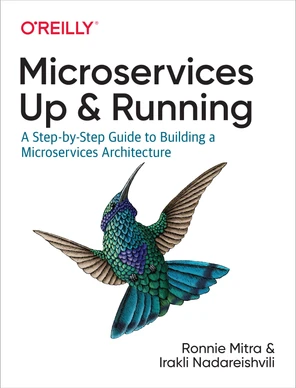
Book overview
A look at the structure and key facts of the book

Publication date
November 25, 2020

Edition
1 edition

Total chapters
12 chapters

Total pages
316 pages

Level
Intermediate to advanced

Microservices architectures offer faster change speeds, better scalability, and cleaner, evolvable system designs. But implementing your first microservices architecture is difficult. How do you make myriad choices, educate your team on all the technical details, and navigate the organization to a successful execution to maximize your chance of success? With this book, authors Ronnie Mitra and Irakli Nadareishvili provide step-by-step guidance for building an effective microservices architecture.
Architects and engineers will follow an implementation journey based on techniques and architectures that have proven to work for microservices systems. You'll build an operating model, a microservices design, an infrastructure foundation, and two working microservices, then put those pieces together as a single implementation. For anyone tasked with building microservices or a microservices architecture, this guide is invaluable.
- Learn an effective and explicit end-to-end microservices system design
- Define teams, their responsibilities, and guidelines for working together
- Understand how to slice a big application into a collection of microservices
- Examine how to isolate and embed data into corresponding microservices
- Build a simple yet powerful CI/CD pipeline for infrastructure changes
- Write code for sample microservices
- Deploy a working microservices application on Amazon Web Services
Browse this section to get a quick overall picture of the book's content.
Microservices Architecture Design
This book helps you create an effective and explicit end-to-end design for microservices systems. You will learn how to slice a large application into a collection of microservices and discover interaction patterns between them.
This section includes processes like SEED(S) for identifying actors, jobs, and interaction patterns, which are essential for establishing appropriate service boundaries. The ultimate goal is to build systems that are scalable, evolvable, and maintainable.
Operating Models and Team Organization
This section addresses the importance of teams and people in the success of microservices architecture. You will learn how to define teams, specify their responsibilities, and establish guidelines for effective inter-team collaboration.
Concepts such as Team Topologies are explored for designing microservices team structures, including platform teams, enabling teams, and consumer teams. This approach helps reduce coordination costs and increase the speed of change.
Data Management in Microservices
The book addresses the challenges of data management in a microservices environment and provides solutions for independent deployability and data sharing. You will learn how to embed and isolate data within corresponding microservices.
Concepts such as the Data Delegate Pattern, using Data Duplication for independence, and more advanced patterns like Event Sourcing and CQRS for managing distributed transactions and improving performance are covered. These approaches help maintain consistency and fault tolerance in the system.
Automated Infrastructure and Deployment
This section focuses on building a robust and automated infrastructure pipeline for microservices. You will become familiar with the principles of DevOps, Immutable Infrastructure, and Infrastructure as Code (IaC).
The book provides practical guidance for setting up an IaC environment using tools like GitHub and Terraform, and teaches how to configure Amazon Web Services (AWS) for microservices deployment. Additionally, deployment on Kubernetes and using Argo CD for GitOps deployment are detailed.
The authors behind this book are among the most prominent experts and pioneers of their field. Their work is the result of years of hands-on experience, deep research and collaboration with the world's largest technology organizations and companies.Each of these authors, through specialist books and articles, has played an important role in shaping and advancing technical knowledge worldwide.


Comments
Readers' experience with this book - comments from buyers and other users
12 chapters in production
Reading time
08:32
Book type
Subscription
Participants
Be the first
Last updated
Sep 30, 2026