

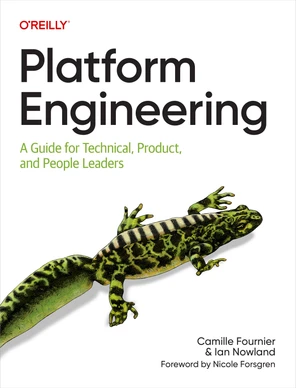
Book Platform Engineering
Until recently, infrastructure was the backbone of organizations operating software they developed in-house. But now that cloud vendors run the computers, companies can finally bring the benefits of agile custom-centricity to their own developers. Adding product management to infrastructure organizations is now all the rage. But how's that possible when infrastructure is still the operational layer of the company? This practical book guides engineers, managers, product managers, and leaders through the shifts that modern platform-led organizations require. You'll learn what platform engineering is—and isn't—and what benefits and value it brings to developers and teams. You'll understand what it means to approach a platform as a product and learn some of the most common technical and managerial barriers to success. With this book, you'll: Cultivate a platform-as-product, developer-centric mindset Learn what platform engineering teams are and are not Start the process of adopting platform engineering within your organization Discover what it takes to become a product manager for a platform team Understand the challenges that emerge when you scale platforms Automate processes and self-service infrastructure to speed development and improve developer experience Build out, hire, manage, and advocate for a platform team
Book chapters
Browse the chapters to quickly get to know the structure and content of the book.
By browsing the chapters of this book you can quickly see what each part teaches, how the whole is structured and where to start. Each chapter focuses on one concept or skill, and you see its main topics so your choice is more informed. Whether you follow the whole book or just one part, this view helps you find your way.
I. The What and Why of Platform Engineering
If you’re reading this book because you are already working in platform engineering and looking for tips on how to do it better, you might be tempted to skip these first couple of chapters. After all, they will hopefully tell you what you already know: why you should be building platforms, and the core pillars that make up the “what” of platform engineering. However, we encourage you to stick with us, because many people don’t get it like you do. These chapters will support you in explaining platform engineering to your colleagues, your boss, and your team, when you’re faced with questions like: What is the motivation for doing it? What are the problems we could be solving with platform engineering? And what does our team need to focus on to do it well?
We start this book with the “why” not only to lay out the reasons we think you should care about building platforms but also to share our motivation for writing the book. We are passionate about solving these problems, and we want to see more of you inspired to solve them as well. Platforms are born from the struggles of modern scaled software engineering: the incredible demands we place on teams to manage a vast ecosystem undergoing rapid change, without sacrificing the availability and performance of their applications. This doesn’t mean that platform engineering can solve ...
1. Why Platform Engineering Is Becoming Essential
2. The Pillars of Platform Engineering
II. Platform Engineering Practices
In Part I, we talked about the “why” and the “what” of platform engineering, and we hope to have convinced most of you of the value of doing more of it in your company. But we’re sure that some of you are still skeptical, wondering whether this isn’t just a rebranding of infrastructure engineering, DevOps, and SRE, where the team promises to develop customer-focused products but really just doubles down on operating a bunch of disjoint OSS and vendor systems. Or you might be skeptical for other reasons; perhaps you’ve had the experience of new leaders coming in from an application/product engineering background who think they can solve all the hard problems of scaled platforms with new software, but who have no deep appreciation of what’s involved in operating critical and complex systems.
We’ve lived through these experiences as well, and our goal for Part II is to teach you how to avoid these outcomes, and so break out of the egg, eventually to fly. To do this, we’re going to spend the next eight chapters—the bulk of the book—talking about the “how” of great platform engineering organizations. We’ll start by discussing getting started, choosing the right people, adopting a product mindset, and operating your platform successfully. Then we’ll move on to the more complex work of planning, rearchitecting, ...
3. How and When to Get Started
4. Building Great Platform Teams
5. Platform as a Product
6. Operating Platforms
7. Planning and Delivery
8. Rearchitecting Platforms
9. Migrations and Sunsetting of Platforms
10. Managing Stakeholder Relationships
III. What Does Success Look Like?
A platform team running as hard as it can can often appear to be making little progress. You get some systems into a steady state, enabling your team to focus on other areas, only to be pulled back a year or two later when the systems are outdated and no longer serve the company. Your paved paths that make the 80% happy still leave the other 20% grumbling that their needs haven’t been addressed. You hire the perfect balanced team, only to go through a budget crunch that forces you to lay off some, or a growth cycle that sees great people leave for greener pastures. On top of this, even when you are progressing, delivering value is slow; it takes time to build a high-quality product, time to convince customers to use it, and time to migrate everyone.
This is why we oppose textbook “metrics and measures” approaches as the primary way of talking about platform engineering success. That’s not to say they are useless; we will cover adoption and customer satisfaction metrics in this part of the book, and ...
11. Your Platforms Are Aligned
12. Your Platforms Are Trusted
13. Your Platforms Manage Complexity
14. Your Platforms Are Loved
14 chapters in production
Reading time
10:45
Book type
Subscription
Participants
Be the first
Last updated
Sep 30, 2026