

Book Reinforcement Learning
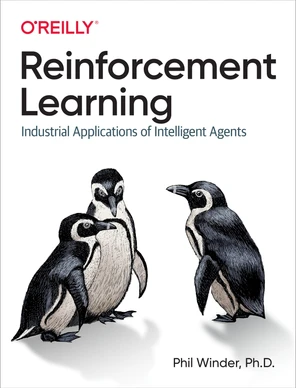
Reinforcement learning (RL) will deliver one of the biggest breakthroughs in AI over the next decade, enabling algorithms to learn from their environment to achieve arbitrary goals. This exciting development avoids constraints found in traditional machine learning (ML) algorithms. This practical book shows data science and AI professionals how to learn by reinforcement and enable a machine to learn by itself. Author Phil Winder of Winder Research covers everything from basic building blocks to state-of-the-art practices. You'll explore the current state of RL, focus on industrial applications, learn numerous algorithms, and benefit from dedicated chapters on deploying RL solutions to production. This is no cookbook; doesn't shy away from math and expects familiarity with ML. * Learn what RL is and how the algorithms help solve problems * Become grounded in RL fundamentals including Markov decision processes, dynamic programming, and temporal difference learning * Dive deep into a range of value and policy gradient methods * Apply advanced RL solutions such as meta learning, hierarchical learning, multi-agent, and imitation learning * Understand cutting-edge deep RL algorithms including Rainbow, PPO, TD3, SAC, and more * Get practical examples through the accompanying website
Book preface
Before you start, a short look at what you will learn in this book
In the preface, settle the general questions you have at a glance, so your view widens and your choice is more informed. Questions such as: Why was this book written and what problem does it solve? Who can use the book? A summary of the chapters and the learning goals of each part? The important changes and new improvements added across editions, and so on — we cover all of these for you.
Target audience
Software engineers and data science professionals who are familiar with machine learning principles and want to enter the field of reinforcement learning. This book helps them learn everything from basics to advanced implementation in a structured manner.
AI researchers and developers looking to master modern algorithms such as deep Q-networks and policy gradient methods. The book's content provides the necessary tools to understand and improve these algorithms.
Industry professionals and production engineers who need to implement and deploy reinforcement learning solutions at an industrial scale. The operational chapters of the book directly address the needs of this group.
Graduate students and machine learning enthusiasts who want to deeply understand the mathematics and implementation details of reinforcement learning. This book serves as a comprehensive and practical reference source.
Why the book was written
Reinforcement learning is one of the major future developments in artificial intelligence that allows algorithms to automatically learn from their environment. This book goes beyond theoretical concepts and provides practical solutions for industrial implementation.
Many traditional resources avoid mathematics and complex details, whereas this book addresses mathematical topics with a deep approach. Readers can master complex algorithms by studying this work and apply them to real projects.
The book specifically addresses the crucial and vital topic of deploying reinforcement learning models in production environments. This feature helps engineers bridge the gap between laboratory research and real-world applications.
The author has extensive experience in machine learning and reinforcement learning consulting and shares valuable insights. Studying this work is very useful for professionals looking to enhance their artificial intelligence skills.
Content overview
As a comprehensive and practical guide, this book paves the way for learning reinforcement learning from basic principles to industrial implementations. The author, with complete command over the concepts, has managed to present complex mathematical and algorithmic topics in a structured manner.
Addressing advanced topics such as deep reinforcement learning and methods based on it has significantly increased the value of this work. After reading the book, the reader gains the necessary ability to solve real-world problems using reinforcement learning.
Special focus on production challenges and deploying models distinguishes this book from other theoretical resources. This feature is extremely valuable for engineers who intend to operationalize artificial intelligence systems on a large scale.
The structure of the book is designed in such a way that the reader can gradually move from simple concepts to advanced algorithms. The presence of case studies and industrial examples greatly helps in better understanding the material.
Published
Reading time
11:49
Book type
Subscription
Participants
Be the first
Last updated
Oct 12, 2026