

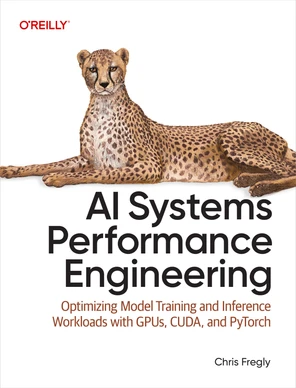
Book AI Systems Performance Engineering
Elevate your AI system performance capabilities with this definitive guide to maximizing efficiency across every layer of your AI infrastructure. In today's era of ever-growing generative models, AI Systems Performance Engineering provides engineers, researchers, and developers with a hands-on set of actionable optimization strategies. Learn to co-optimize hardware, software, and algorithms to build resilient, scalable, and cost-effective AI systems that excel in both training and inference. Authored by Chris Fregly, a performance-focused engineering and product leader, this resource transforms complex AI systems into streamlined, high-impact AI solutions. Inside, you'll discover step-by-step methodologies for fine-tuning GPU CUDA kernels, PyTorch-based algorithms, and multinode training and inference systems. You'll also master the art of scaling GPU clusters for high performance, distributed model training jobs, and inference servers. The book ends with a 175+-item checklist of proven, ready-to-use optimizations.
Book chapters
Browse the chapters to quickly get to know the structure and content of the book.
By browsing the chapters of this book you can quickly see what each part teaches, how the whole is structured and where to start. Each chapter focuses on one concept or skill, and you see its main topics so your choice is more informed. Whether you follow the whole book or just one part, this view helps you find your way.
1. Introduction and AI System Overview
2. AI System Hardware Overview
3. OS, Docker, and Kubernetes Tuning for GPU-Based Environments
4. Tuning Distributed Networking Communication
5. GPU-Based Storage I/O Optimizations
6. GPU Architecture, CUDA Programming, and Maximizing Occupancy
7. Profiling and Tuning GPU Memory Access Patterns
8. Occupancy Tuning, Warp Efficiency, and Instruction-Level Parallelism
9. Increasing CUDA Kernel Efficiency and Arithmetic Intensity
10. Intra-Kernel Pipelining, Warp Specialization, and Cooperative Thread Block Clusters
11. Inter-Kernel Pipelining, Synchronization, and CUDA Stream-Ordered Memory Allocations
12. Dynamic Scheduling, CUDA Graphs, and Device-Initiated Kernel Orchestration
13. Profiling, Tuning, and Scaling PyTorch
14. PyTorch Compiler, OpenAI Triton, and XLA Backends
15. Multinode Inference, Parallelism, Decoding, and Routing Optimizations
16. Profiling, Debugging, and Tuning Inference at Scale
17. Scaling Disaggregated Prefill and Decode for Inference
18. Advanced Prefill-Decode and KV Cache Tuning
19. Dynamic and Adaptive Inference Engine Optimizations
20. AI-Assisted Performance Optimizations and Scaling Toward Multimillion GPU Clusters
Published
Reading time
34:20
Book type
Subscription
Participants
Be the first
Last updated
Nov 16, 2026