

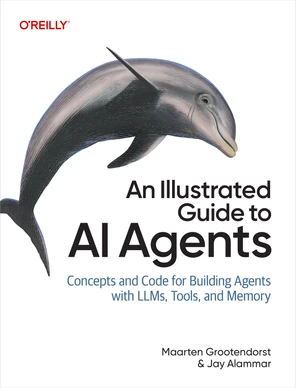
Book An Illustrated Guide to AI Agents
Artificial intelligence is entering a new phase. AI agents can now reason, plan, and act with increasing independence. From accelerating scientific breakthroughs to supporting creative work, these systems are quickly reshaping industries and everyday life. This book provides the conceptual foundation and practical insights you need to understand—and effectively work with—this emerging technology. Through hundreds of clear graphic illustrations, Maarten Grootendorst and Jay Alammar explain how AI agents are built, how they think, and where they're heading. Designed for professionals, students, and curious learners alike, this guide goes beyond the buzz to reveal what's actually happening inside these systems, why it matters, and how to apply the knowledge in real-world contexts. An Illustrated Guide to AI Agents is your essential reference for navigating the next frontier of artificial intelligence. * Explore the core architecture of AI agents: tools, memory, and planning * Understand reasoning LLMs, multimodal models, and multi-agent collaboration * Learn advanced methods, including distillation, quantization, and reinforcement learning * Evaluate real-world applications, strengths, and limitations of AI agents
Book preface
Before you start, a short look at what you will learn in this book
In the preface, settle the general questions you have at a glance, so your view widens and your choice is more informed. Questions such as: Why was this book written and what problem does it solve? Who can use the book? A summary of the chapters and the learning goals of each part? The important changes and new improvements added across editions, and so on — we cover all of these for you.
Target audience
This book is ideal for professionals working in AI, machine learning, or software development who need to understand and implement AI agents. It covers core architectures, advanced methods like reinforcement learning, and practical evaluation techniques, equipping them with the knowledge to build and deploy sophisticated agentic systems.
Students and researchers looking to deepen their understanding of AI agents will find this guide invaluable. It provides a solid conceptual foundation, explores reasoning LLMs, multimodal models, and multi-agent collaboration, offering a comprehensive resource for academic study and cutting-edge research.
Curious Learners and Tech Enthusiasts: Individuals with a general interest in artificial intelligence and its future will benefit from this book's accessible approach. It goes beyond the hype to explain the inner workings of AI agents, their impact on industries, and how they are reshaping everyday life, all presented with clear graphic illustrations.
Engineers and Architects of Intelligent Systems: Those involved in designing or architecting intelligent systems will find practical insights into building robust and effective AI agents. The book covers critical aspects like tool usage, memory management, and planning, along with methods for evaluating agent performance and ensuring reliability and safety.
Why the book was written
This book is essential for anyone seeking to grasp the current evolution of artificial intelligence, particularly with the rise of autonomous AI agents. It provides a comprehensive overview of how these systems are reasoning, planning, and acting with increasing independence, which is crucial for staying current in the rapidly changing AI landscape.
The guide aims to offer both the theoretical foundations and practical insights necessary to effectively work with emerging AI agent technology. It helps readers move beyond surface-level understanding to delve into the internal workings of these systems, making complex concepts accessible through clear explanations and illustrations.
With AI agents reshaping industries and daily life, this book serves as a vital reference for professionals, students, and curious learners. It explains the significance of these advancements and demonstrates how the acquired knowledge can be applied in real-world contexts, preparing readers for the next frontier of AI.
The authors use hundreds of graphic illustrations to explain the intricate details of how AI agents are built and how they "think." This visual approach helps demystify the complex architecture, including tools, memory, and planning, making it easier for readers to understand the underlying mechanisms and design principles.
Content overview
This book provides a solid conceptual foundation for understanding the emerging field of AI agents, detailing how these systems reason, plan, and act with increasing independence. It effectively bridges the gap between theoretical knowledge and practical application, making complex topics accessible.
The guide excels in its use of hundreds of clear graphic illustrations, which significantly aid in explaining the intricate construction and thought processes of AI agents. This visual approach helps readers grasp how these systems are built, how they function, and their future trajectory.
It offers a comprehensive exploration of core AI agent architectures, including tools, memory, and planning, alongside advanced topics such as reasoning LLMs, multimodal models, and multi-agent collaboration. The book also delves into advanced methods like distillation and reinforcement learning.
The resource is highly valuable for professionals, students, and curious learners, as it moves beyond superficial discussions to reveal the actual mechanisms inside AI systems. It provides essential insights into real-world applications, strengths, and limitations, serving as a crucial reference for navigating the evolving landscape of artificial intelligence.
Published
Reading time
11:50
Book type
Subscription
Participants
1 readers
Last updated
Nov 16, 2026