

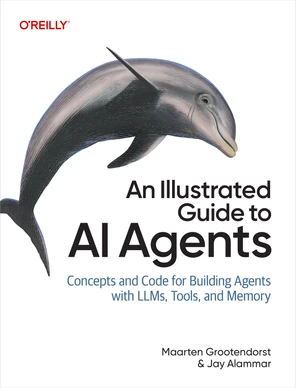
Book An Illustrated Guide to AI Agents
Artificial intelligence is entering a new phase. AI agents can now reason, plan, and act with increasing independence. From accelerating scientific breakthroughs to supporting creative work, these systems are quickly reshaping industries and everyday life. This book provides the conceptual foundation and practical insights you need to understand—and effectively work with—this emerging technology. Through hundreds of clear graphic illustrations, Maarten Grootendorst and Jay Alammar explain how AI agents are built, how they think, and where they're heading. Designed for professionals, students, and curious learners alike, this guide goes beyond the buzz to reveal what's actually happening inside these systems, why it matters, and how to apply the knowledge in real-world contexts. An Illustrated Guide to AI Agents is your essential reference for navigating the next frontier of artificial intelligence. * Explore the core architecture of AI agents: tools, memory, and planning * Understand reasoning LLMs, multimodal models, and multi-agent collaboration * Learn advanced methods, including distillation, quantization, and reinforcement learning * Evaluate real-world applications, strengths, and limitations of AI agents
Book chapters
Browse the chapters to quickly get to know the structure and content of the book.
By browsing the chapters of this book you can quickly see what each part teaches, how the whole is structured and where to start. Each chapter focuses on one concept or skill, and you see its main topics so your choice is more informed. Whether you follow the whole book or just one part, this view helps you find your way.
I. The Anatomy of an AI Agent
This part provides the foundational understanding of AI agents, dissecting their core components and operational mechanisms. It covers the fundamental architecture, including how large language models are augmented, memory systems, tool usage, and planning capabilities. Readers will also learn about evaluating agent performance and the paradigm shift from train-time to test-time compute.
1. Introduction
2. Large Language Models
3. Reasoning Large Language Models
4. Memory
5. Tool Usage, Learning, and Protocols
6. Planning and Reflection
7. Evaluating Agents
II. Specialized Agents
This part explores advanced and specialized applications of AI agents, focusing on their capabilities in complex environments. It delves into multi-agent systems, where multiple agents collaborate, and multi-modal understanding, enabling agents to process diverse data types. The section also covers the development and application of code agents and code LLMs for software engineering tasks.
8. Multi-Agent Systems
9. Multi-Modal Understanding
10. Code Agents and Code LLMs
Published
Reading time
11:50
Book type
Subscription
Participants
1 readers
Last updated
Nov 16, 2026