

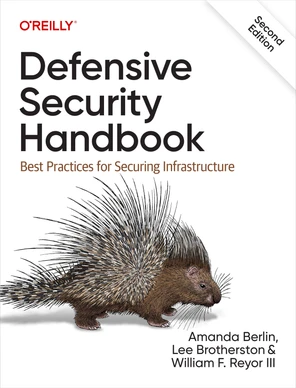
Book Defensive Security Handbook, 2nd Edition
Despite the increase of high-profile hacks, record-breaking data leaks, and ransomware attacks, many organizations don't have the budget for an information security (InfoSec) program. If you're forced to protect yourself by improvising on the job, this pragmatic guide provides a security-101 handbook with steps, tools, processes, and ideas to help you drive maximum-security improvement at little or no cost. Each chapter in this book provides step-by-step instructions for dealing with issues such as breaches and disasters, compliance, network infrastructure, password management, vulnerability scanning, penetration testing, and more. Network engineers, system administrators, and security professionals will learn how to use frameworks, tools, and techniques to build and improve their cybersecurity programs. This book will help you: Plan and design incident response, disaster recovery, compliance, and physical security Learn and apply basic penetration-testing concepts through purple teaming Conduct vulnerability management using automated processes and tools Use IDS, IPS, SOC, logging, and monitoring Bolster Microsoft and Unix systems, network infrastructure, and password management Use segmentation practices and designs to compartmentalize your network Reduce exploitable errors by developing code securely
Book overview
A look at the structure and key facts of the book

Publication date
June 26, 2024

Edition
2 edition

Total chapters
23 chapters

Total pages
362 pages

Level
Intermediate to advanced

Despite the increase of high-profile hacks, record-breaking data leaks, and ransomware attacks, many organizations don't have the budget for an information security (InfoSec) program. If you're forced to protect yourself by improvising on the job, this pragmatic guide provides a security-101 handbook with steps, tools, processes, and ideas to help you drive maximum-security improvement at little or no cost.
Each chapter in this book provides step-by-step instructions for dealing with issues such as breaches and disasters, compliance, network infrastructure, password management, vulnerability scanning, penetration testing, and more. Network engineers, system administrators, and security professionals will learn how to use frameworks, tools, and techniques to build and improve their cybersecurity programs.
This book will help you:
- Plan and design incident response, disaster recovery, compliance, and physical security
- Learn and apply basic penetration-testing concepts through purple teaming
- Conduct vulnerability management using automated processes and tools
- Use IDS, IPS, SOC, logging, and monitoring
- Bolster Microsoft and Unix systems, network infrastructure, and password management
- Use segmentation practices and designs to compartmentalize your network
- Reduce exploitable errors by developing code securely
Browse this section to get a quick overall picture of the book's content.
Building a Foundational Security Program
This book provides a pragmatic guide for establishing and improving an information security (InfoSec) program, especially for organizations with limited budgets. It covers essential steps from laying the groundwork and establishing security teams to assessing threats, managing risks, and prioritizing security initiatives.
The focus is on creating a robust security posture from the ground up, ensuring that fundamental security practices are in place. This approach helps organizations build a strong security framework despite resource constraints.
Implementing Defensive Security Controls
The handbook details practical defensive techniques for securing various IT components. It provides instructions for bolstering Microsoft and Unix systems, hardening network infrastructure, and implementing effective password management strategies.
Furthermore, it covers vulnerability management, the use of intrusion detection/prevention systems (IDS/IPS), security operations centers (SOC), logging, and monitoring to actively protect against threats. This section helps readers strengthen their defenses against cyberattacks.
Incident Response and Business Continuity
A significant portion of the book is dedicated to preparing for and responding to security incidents and disasters. It guides readers through planning and designing robust incident response and disaster recovery strategies, including setting objectives like RPO (Recovery Point Objective) and RTO (Recovery Time Objective).
The content also addresses compliance standards and physical security, ensuring organizations can maintain operations and recover effectively after a security event. This comprehensive approach helps maintain business stability.
The authors behind this book are among the most prominent experts and pioneers of their field. Their work is the result of years of hands-on experience, deep research and collaboration with the world's largest technology organizations and companies.Each of these authors, through specialist books and articles, has played an important role in shaping and advancing technical knowledge worldwide.



Comments
Readers' experience with this book - comments from buyers and other users
23 chapters in production
Reading time
10:52
Book type
Subscription
Participants
Be the first
Last updated
Sep 30, 2026