

Book Designing Distributed Systems, 2nd Edition
Every distributed system strives for reliability, performance, and quality, but building such a system is hard. Establishing a set of design patterns enables software developers and system architects to use a common language to describe their systems and learn from the patterns and practices developed by others. The popularity of containers and Kubernetes paves the way for core distributed system patterns and reusable containerized components. This practical guide presents a collection of repeatable, generic patterns to help guide the systems you build using common patterns and practices drawn from some of the highest performing distributed systems in use today. These common patterns make the systems you build far more approachable and efficient, even if you've never built a distributed system before. Author Brendan Burns demonstrates how you can adapt existing software design patterns for designing and building reliable distributed applications. Systems engineers and application developers will learn how these long-established patterns provide a common language and framework for dramatically increasing the quality of your system. This fully updated second edition includes new chapters on AI inference, AI training, and building robust systems for the real world. Understand how patterns and reusable components enable the rapid development of reliable distributed systems Use the sidecar, adapter, and ambassador patterns to split your application into a group of containers on a single machine Explore loosely coupled multinode distributed patterns for replication, scaling, and communication between components Learn distributed system patterns for large-scale batch data processing covering work queues, event-based processing, and coordinated workflows
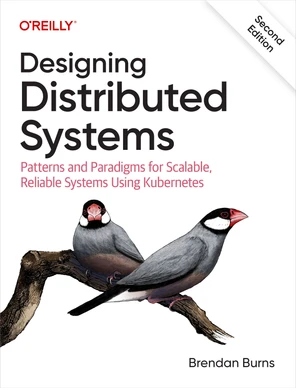
Book overview
A look at the structure and key facts of the book

Publication date
December 4, 2024

Edition
2 edition

Total chapters
16 chapters

Total pages
220 pages

Level
Intermediate to advanced

Every distributed system strives for reliability, performance, and quality, but building such a system is hard. Establishing a set of design patterns enables software developers and system architects to use a common language to describe their systems and learn from the patterns and practices developed by others.
The popularity of containers and Kubernetes paves the way for core distributed system patterns and reusable containerized components. This practical guide presents a collection of repeatable, generic patterns to help guide the systems you build using common patterns and practices drawn from some of the highest performing distributed systems in use today. These common patterns make the systems you build far more approachable and efficient, even if you've never built a distributed system before.
Author Brendan Burns demonstrates how you can adapt existing software design patterns for designing and building reliable distributed applications. Systems engineers and application developers will learn how these long-established patterns provide a common language and framework for dramatically increasing the quality of your system.
This fully updated second edition includes new chapters on AI inference, AI training, and building robust systems for the real world.
- Understand how patterns and reusable components enable the rapid development of reliable distributed systems
- Use the sidecar, adapter, and ambassador patterns to split your application into a group of containers on a single machine
- Explore loosely coupled multinode distributed patterns for replication, scaling, and communication between components
- Learn distributed system patterns for large-scale batch data processing covering work queues, event-based processing, and coordinated workflows
Browse this section to get a quick overall picture of the book's content.
Single-Node Container Patterns
This structural domain focuses on grouping colocated containers on a single machine to establish clear operational boundaries. Utilizing patterns like Sidecar, Adapter, and Ambassador enables seamless separation of concerns and resource isolation.
Developers can augment applications with capabilities like monitoring, logging normalization, and security proxying without modifying core application code.
- Sidecar pattern for modular application extensions
- Ambassador pattern for proxying and request splitting
- Adapter pattern for standardized monitoring and logging interfaces
Multinode Serving and Distributed Patterns
This pattern set explores loosely coupled distributed components running across multiple nodes in a network. It covers mechanisms for replication, scaling, and handling network-based communications effectively.
Building resilient multi-node architectures requires leveraging patterns such as sharding, scatter/gather processing, and leader election for coordination.
- Replicated load-balanced services for high availability
- Sharded architectures for distributed caching and storage
- Scatter/Gather patterns for parallel request handling
Batch Processing and Event-Driven Patterns
Large-scale data operations demand efficient, short-lived computational patterns that maximize parallelism. Work queues and event-driven workflows provide scalable structures for complex batch operations.
Using tools like Kafka alongside generic work queue designs enables resilient and coordinated batch processing pipelines.
- Work queue systems for dynamic worker scaling
- Event-driven pipelines using publish/subscribe infrastructure
- Coordinated batch processing with join and reduce primitives
The authors behind this book are among the most prominent experts and pioneers of their field. Their work is the result of years of hands-on experience, deep research and collaboration with the world's largest technology organizations and companies.Each of these authors, through specialist books and articles, has played an important role in shaping and advancing technical knowledge worldwide.

Comments
Readers' experience with this book - comments from buyers and other users
16 chapters in production
Reading time
05:59
Book type
Subscription
Participants
Be the first
Last updated
Sep 30, 2026