

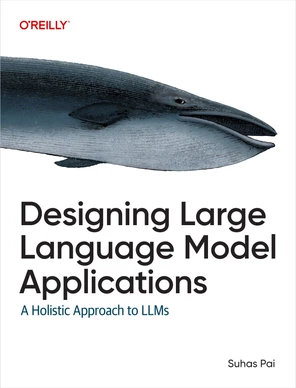
Book Designing Large Language Model Applications
Large language models (LLMs) have proven themselves to be powerful tools for solving a wide range of tasks, and enterprises have taken note. But transitioning from demos and prototypes to full-fledged applications can be difficult. This book helps close that gap, providing the tools, techniques, and playbooks that practitioners need to build useful products that incorporate the power of language models. Experienced ML researcher Suhas Pai offers practical advice on harnessing LLMs for your use cases and dealing with commonly observed failure modes. You’ll take a comprehensive deep dive into the ingredients that make up a language model, explore various techniques for customizing them such as fine-tuning, learn about application paradigms like RAG (retrieval-augmented generation) and agents, and more.
Book chapters
Browse the chapters to quickly get to know the structure and content of the book.
By browsing the chapters of this book you can quickly see what each part teaches, how the whole is structured and where to start. Each chapter focuses on one concept or skill, and you see its main topics so your choice is more informed. Whether you follow the whole book or just one part, this view helps you find your way.
I. LLM Ingredients
We begin this book by introducing large language models (LLMs) and the key ingredients that go into making them. This includes understanding how training data is collected and prepared, examining the model’s vocabulary, and exploring the architectures underpinning them.
1. Introduction
2. Pre-Training Data
3. Vocabulary and Tokenization
4. Architectures and Learning Objectives
II. Utilizing LLMs
In this part of the book, we will explore how to harness and adapt pre-trained LLMs to solve various kinds of language tasks that we introduced in Chapter 1. To make the best use of these chapters, I strongly suggest that you experiment hands-on with all the techniques introduced, as well as run the corresponding tutorials from the accompanying GitHub repo for this book.
5. Adapting LLMs to Your Use Case
6. Fine-Tuning
7. Advanced Fine-Tuning Techniques
8. Alignment Training and Reasoning
9. Inference Optimization
III. LLM Application Paradigms
In this part of the book, we shift our focus to the application layer. Until now, we have explored LLMs as standalone concepts, but we will now examine how they integrate into larger software systems. To this end, we will delve into popular application paradigms such as retrieval-augmented generation (RAG) and agents.
10. Interfacing LLMs with External Tools
11. Representation Learning and Embeddings
12. Retrieval-Augmented Generation
13. Design Patterns and System Architecture
13 chapters in production
Reading time
09:31
Book type
Subscription
Participants
Be the first
Last updated
Sep 30, 2026