

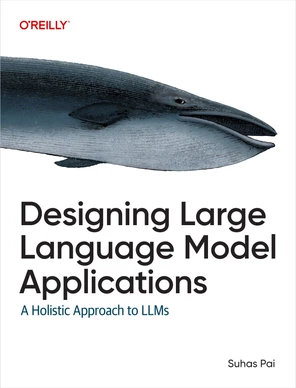
Book Designing Large Language Model Applications
Large language models (LLMs) have proven themselves to be powerful tools for solving a wide range of tasks, and enterprises have taken note. But transitioning from demos and prototypes to full-fledged applications can be difficult. This book helps close that gap, providing the tools, techniques, and playbooks that practitioners need to build useful products that incorporate the power of language models. Experienced ML researcher Suhas Pai offers practical advice on harnessing LLMs for your use cases and dealing with commonly observed failure modes. You’ll take a comprehensive deep dive into the ingredients that make up a language model, explore various techniques for customizing them such as fine-tuning, learn about application paradigms like RAG (retrieval-augmented generation) and agents, and more.
Book preface
Before you start, a short look at what you will learn in this book
In the preface, settle the general questions you have at a glance, so your view widens and your choice is more informed. Questions such as: Why was this book written and what problem does it solve? Who can use the book? A summary of the chapters and the learning goals of each part? The important changes and new improvements added across editions, and so on — we cover all of these for you.
Target audience
Machine learning engineers who intend to deploy language models at an enterprise scale. This book is highly useful for those looking to optimize model performance.
Software developers who want to add AI capabilities to their applications. The book helps them make the best use of available tools.
AI researchers looking for a deeper understanding of transformer architectures and fine-tuning methods. The content balances theory and practice effectively.
Technical managers responsible for overseeing AI projects. They can make more informed decisions regarding model selection and implementation strategies by reading this book.
Why the book was written
This book bridges the gap between experimental prototypes and production-ready applications. The author provides the necessary tools for building real-world products.
The content focuses on real-world challenges such as managing model hallucinations and inference optimization. This approach helps practitioners tackle common issues in enterprise environments.
The book provides a comprehensive guide from theoretical foundations to advanced implementations. This structure allows the reader to gain a deep understanding of underlying architectures.
By utilizing modern design patterns like RAG and autonomous agents, the reader learns how to integrate models into existing software ecosystems. This skill is essential for modern developers.
Content overview
This book is an essential resource for anyone looking to move beyond superficial uses of language models. The author's practical approach makes complex concepts understandable.
The comprehensive coverage of topics from pre-training to optimized inference makes this book a complete reference. Readers can apply the provided playbooks to their own projects.
The focus on design patterns like RAG and agents aligns the book with current industry needs. It effectively demonstrates how to interface models with external tools.
Suhas Pai helps the reader avoid common pitfalls by providing practical examples and examining failure modes. This book is valuable for any engineering team working with LLMs.
13 chapters in production
Reading time
09:31
Book type
Subscription
Participants
Be the first
Last updated
Sep 30, 2026