

Book Designing Machine Learning Systems
Machine learning systems are both complex and unique. Complex because they consist of many different components and involve many different stakeholders. Unique because they're data dependent, with data varying wildly from one use case to the next. In this book, you'll learn a holistic approach to designing ML systems that are reliable, scalable, maintainable, and adaptive to changing environments and business requirements. Author Chip Huyen, co-founder of Claypot AI, considers each design decision--such as how to process and create training data, which features to use, how often to retrain models, and what to monitor--in the context of how it can help your system as a whole achieve its objectives. The iterative framework in this book uses actual case studies backed by ample references. This book will help you tackle scenarios such as: Engineering data and choosing the right metrics to solve a business problem Automating the process for continually developing, evaluating, deploying, and updating models Developing a monitoring system to quickly detect and address issues your models might encounter in production Architecting an ML platform that serves across use cases Developing responsible ML systems
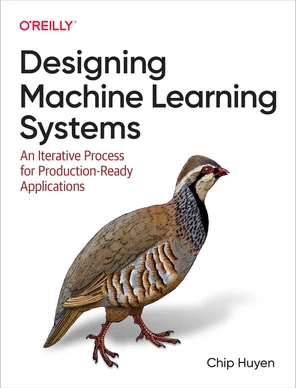
Book overview
A look at the structure and key facts of the book

Publication date
May 17, 2022

Edition
1 edition

Total chapters
11 chapters

Total pages
386 pages

Level
Intermediate to advanced

Machine learning systems are both complex and unique. Complex because they consist of many different components and involve many different stakeholders. Unique because they're data dependent, with data varying wildly from one use case to the next. In this book, you'll learn a holistic approach to designing ML systems that are reliable, scalable, maintainable, and adaptive to changing environments and business requirements.
Author Chip Huyen, co-founder of Claypot AI, considers each design decision--such as how to process and create training data, which features to use, how often to retrain models, and what to monitor--in the context of how it can help your system as a whole achieve its objectives. The iterative framework in this book uses actual case studies backed by ample references.
This book will help you tackle scenarios such as:
- Engineering data and choosing the right metrics to solve a business problem
- Automating the process for continually developing, evaluating, deploying, and updating models
- Developing a monitoring system to quickly detect and address issues your models might encounter in production
- Architecting an ML platform that serves across use cases
- Developing responsible ML systems
Browse this section to get a quick overall picture of the book's content.
Holistic Design and Architecture of ML Systems
Building production-grade machine learning systems requires balancing data dependencies, infrastructure requirements, and business goals. The book outlines an end-to-end architecture that covers data engineering, model training, deployment, and continuous monitoring. It provides a structured framework to ensure ML models remain reliable, scalable, and maintainable in real-world environments.
Key architectural focus areas include:
- Establishing robust data pipelines for feature extraction and training
- Unifying batch and streaming workflows for real-time predictions
- Implementing scalable deployment strategies across cloud and edge infrastructure
Data Distribution Shifts and Production Monitoring
Deploying models into production is only the beginning, as real-world data constantly changes and degrades model accuracy. This work explores how to detect and handle data distribution shifts such as covariate shift and concept drift. It offers actionable strategies to monitor performance metrics, observe system behavior, and execute automated retraining.
Essential practices covered include:
- Detecting shifts in input data distributions and feature drift early
- Setting up real-time observability for model predictions and system health
- Implementing continual learning loops and deployment testing strategies
The authors behind this book are among the most prominent experts and pioneers of their field. Their work is the result of years of hands-on experience, deep research and collaboration with the world's largest technology organizations and companies.Each of these authors, through specialist books and articles, has played an important role in shaping and advancing technical knowledge worldwide.

Comments
Readers' experience with this book - comments from buyers and other users
Published
Reading time
12:25
Book type
Subscription
Participants
Be the first
Last updated
Nov 16, 2026