

Book Designing Machine Learning Systems
Machine learning systems are both complex and unique. Complex because they consist of many different components and involve many different stakeholders. Unique because they're data dependent, with data varying wildly from one use case to the next. In this book, you'll learn a holistic approach to designing ML systems that are reliable, scalable, maintainable, and adaptive to changing environments and business requirements. Author Chip Huyen, co-founder of Claypot AI, considers each design decision--such as how to process and create training data, which features to use, how often to retrain models, and what to monitor--in the context of how it can help your system as a whole achieve its objectives. The iterative framework in this book uses actual case studies backed by ample references. This book will help you tackle scenarios such as: Engineering data and choosing the right metrics to solve a business problem Automating the process for continually developing, evaluating, deploying, and updating models Developing a monitoring system to quickly detect and address issues your models might encounter in production Architecting an ML platform that serves across use cases Developing responsible ML systems
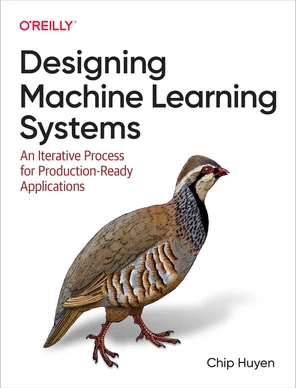
Book preface
Before you start, a short look at what you will learn in this book
In the preface, settle the general questions you have at a glance, so your view widens and your choice is more informed. Questions such as: Why was this book written and what problem does it solve? Who can use the book? A summary of the chapters and the learning goals of each part? The important changes and new improvements added across editions, and so on — we cover all of these for you.
Target audience
Machine learning engineers aiming to transition their models from experimental notebooks to scalable production systems.
This book supplies the architectural insights needed to manage real-time deployment and monitoring.
Data scientists who want a deeper understanding of data infrastructure, feature engineering, and the end-to-end MLOps lifecycle.
Reading this work helps them write production-ready code that aligns with traditional software constraints.
System architects and software engineers responsible for integrating machine learning components into existing software infrastructures.
The content highlights data-centric principles for designing highly maintainable architectures.
Engineering leads and AI team managers planning to build holistic machine learning platforms for enterprise needs.
This text clarifies team structure choices and frameworks for deploying responsible AI systems.
Why the book was written
Designing machine learning systems requires a fundamentally different approach than traditional software due to heavy data dependencies and complex component interactions.
This book provides an iterative framework to help engineers successfully transition isolated AI models into reliable, production-ready systems.
Operational challenges like model degradation and data distribution shifts demand specialized methodologies for continuous monitoring and updating.
This resource delivers the necessary tools and principles to maintain model performance and accuracy over time.
Bridging the gap between research experiments and production environments requires comprehensive knowledge across infrastructure, data engineering, and MLOps.
The book guides readers in architecting scalable platforms capable of supporting diverse business use cases.
Developing responsible AI while meeting ethical and technical standards is a crucial requirement for modern software production.
The author shares a step-by-step approach to mitigating risks and tackling real-world failure scenarios effectively.
Content overview
This book provides a thorough and practical roadmap for taking machine learning models into real-world production.
The author successfully unifies complex concepts across infrastructure, data, and modeling into a clear, cohesive guide.
The deep dive into data-centric challenges like distribution shifts and data leakage stands out as a core strength of this work.
Offering actionable techniques for continuous monitoring and retraining significantly enhances its technical value.
The book brilliantly contrasts traditional software development with the unique demands of machine learning systems.
Its focus on real-world case studies and trade-off analyses prepares readers to tackle real engineering problems.
A comprehensive review of MLOps tools, in-production testing strategies, and responsible AI makes this text an industry standard.
The accessible writing style and structured chapter flow facilitate smooth learning of advanced topics.
Published
Reading time
12:25
Book type
Subscription
Participants
Be the first
Last updated
Nov 16, 2026