

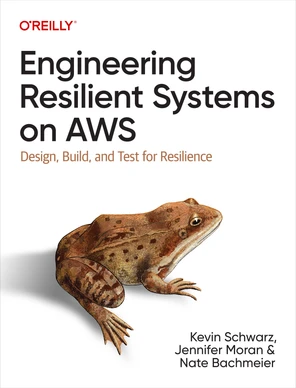
Book Engineering Resilient Systems on AWS
To ensure that applications are reliable and always available, more businesses today are moving applications to AWS. But many companies still struggle to design and build these cloud applications effectively, thinking that because the cloud is resilient, their applications will be too. With this practical guide, software, DevOps, and cloud engineers will learn how to implement resilient designs and configurations in the cloud using hands-on independent labs. Authors Kevin Schwarz, Jennifer Moran, and Dr. Nate Bachmeier from AWS teach you how to build cloud applications that demonstrate resilience with patterns like back off and retry, multi-Region failover, data protection, and circuit breaker with common configuration, tooling, and deployment scenarios. Labs are organized into categories based on complexity and topic, making it easy for you to focus on the most relevant parts of your business. You'll learn how to: Configure and deploy AWS services using resilience patterns Implement stateless microservices for high availability Consider multi-Region designs to meet business requirements Implement backup and restore, pilot light, warm standby, and active-active strategies Build applications that withstand AWS Region and Availability Zone impairments Use chaos engineering experiments for fault injection to test for resilience Assess the trade-offs when building resilient systems, including cost, complexity, and operational burden
Book preface
Before you start, a short look at what you will learn in this book
In the preface, settle the general questions you have at a glance, so your view widens and your choice is more informed. Questions such as: Why was this book written and what problem does it solve? Who can use the book? A summary of the chapters and the learning goals of each part? The important changes and new improvements added across editions, and so on — we cover all of these for you.
Target audience
Software engineers who want to harden their microservices and APIs against unexpected faults and latencies. They will benefit directly from practical patterns like retries and circuit breakers.
DevOps and cloud engineers tasked with deploying, managing infrastructure, and maintaining business continuity. The book offers comprehensive strategies for multi-Region configurations and disaster recovery.
System architects who must make trade-off decisions between application criticality levels and operational costs. The content helps them choose appropriate strategies such as Active-Active or Warm Standby.
Operations and reliability teams aiming to improve observability and end-to-end tracing across distributed services. This resource covers monitoring and troubleshooting multi-region cloud systems.
Why the book was written
Migrating applications to cloud platforms alone does not guarantee their reliability and continuous availability. Engineers require practical patterns to construct systems that can withstand infrastructure impairments.
Fundamental differences between traditional data center resilience and cloud architecture necessitate a shift in engineering mindset. This book provides clear guidance for transitioning from heavy infrastructure investments to flexible cloud strategies.
Building mission-critical applications requires balancing cost, complexity, and operational overhead. Assessing these trade-offs in production environments becomes straightforward through practical hands-on scenarios.
Employing chaos engineering experiments for proactive fault injection has become essential for modern cloud environments. This guide teaches actionable techniques to test and validate system durability.
Content overview
This work delivers a thoroughly practical approach to implementing resilience on AWS, with hands-on exercises directly applicable to real-world scenarios.
The distinguished authors from AWS succeed in simplifying complex multi-Region architectures and chaos engineering into clear, manageable steps.
The thorough examination of operational trade-offs regarding costs and complexity makes this book an invaluable reference for system architects.
Comprehensive coverage ranging from microservices design to disaster recovery strategies provides a complete guide for engineering teams.
11 chapters in production
Reading time
09:36
Book type
Subscription
Participants
Be the first
Last updated
Sep 30, 2026