

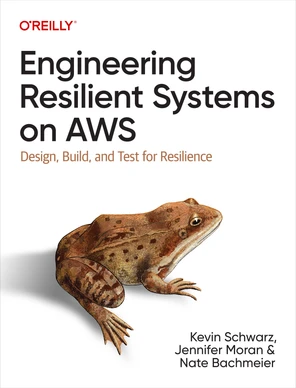
Book Engineering Resilient Systems on AWS
To ensure that applications are reliable and always available, more businesses today are moving applications to AWS. But many companies still struggle to design and build these cloud applications effectively, thinking that because the cloud is resilient, their applications will be too. With this practical guide, software, DevOps, and cloud engineers will learn how to implement resilient designs and configurations in the cloud using hands-on independent labs. Authors Kevin Schwarz, Jennifer Moran, and Dr. Nate Bachmeier from AWS teach you how to build cloud applications that demonstrate resilience with patterns like back off and retry, multi-Region failover, data protection, and circuit breaker with common configuration, tooling, and deployment scenarios. Labs are organized into categories based on complexity and topic, making it easy for you to focus on the most relevant parts of your business. You'll learn how to: Configure and deploy AWS services using resilience patterns Implement stateless microservices for high availability Consider multi-Region designs to meet business requirements Implement backup and restore, pilot light, warm standby, and active-active strategies Build applications that withstand AWS Region and Availability Zone impairments Use chaos engineering experiments for fault injection to test for resilience Assess the trade-offs when building resilient systems, including cost, complexity, and operational burden
Book chapters
Browse the chapters to quickly get to know the structure and content of the book.
By browsing the chapters of this book you can quickly see what each part teaches, how the whole is structured and where to start. Each chapter focuses on one concept or skill, and you see its main topics so your choice is more informed. Whether you follow the whole book or just one part, this view helps you find your way.
I. Foundations
Traditionally, resilient design involved a series of established practices centered on physical infrastructure, redundancy, and failover mechanisms within a company’s data center. However, these practices have evolved significantly with the advent of cloud computing. This book helps you understand the differences between traditional resilient design and resilient design in the cloud.
Organizations typically invest in duplicate hardware systems, such as servers, storage devices, and network components. This redundancy ensures that if one piece of hardware fails, another can take over without significant disruption.
To safeguard against catastrophic events, like natural disasters, companies often maintain multiple data centers in different geographic locations. Data and applications are replicated across these sites to enable failover if one data center becomes inoperable. Detailed disaster recovery plans are developed and regularly tested to ensure business operations can be quickly restored following a major incident. These plans often include backup procedures, manual intervention steps, and predefined recovery time objectives (RTOs). Monitoring hardware performance and regular maintenance is crucial for preemptively addressing potential issues before they lead to system failure.
While these methods have been effective, they come with significant costs and complexities. The capital expenditure required for duplicate hardware, the operational costs of running ...
1. Introduction
2. Prepare Your Working Environment
II. Reliable Trading Portal
In Part II, you’ll embark on the journey into reliable system architectures, building a comprehensive trading portal for a brokerage company. This includes developing both the microservices backend and a resilient frontend web application. You’ll assess foundational components for building mission-critical websites, balancing costs for varying levels of criticality (e.g., external customer-facing site versus internal employee portal). This section includes three core examples:
- A global customer-facing site with a focus on optimizing the frontend web application for performance, scalability, and resilience.
- An account open microservice, ensuring a seamless and secure onboarding process for new customers.
- A stock trading microservice, capable of handling high-volume transactions with low latency and robust error handling.
You’ll plan, implement, and validate resiliency patterns across the entire application stack, leveraging AWS managed services to streamline development and enhance reliability.
3. Frontend Web Application
4. Serverless Account Open API
5. Containerized Trade Stock API
6. Integrated AvailableTrade Frontend with APIs
7. When Recovery Is Required
III. Discovering Trading Opportunities
As a trader or financial analyst, your objective is to identify profitable opportunities by buying low and selling high. But how do you determine what price points are considered low or high? The answer lies in leveraging technical analysis and fundamental research to make informed trading decisions.
In this part of the book, you’ll embark on a journey to build a market analysis solution that empowers you to discover trading opportunities by harnessing the power of real-time market data, news insights, and resilient streaming architectures. You’ll learn how to engineer systems that consume high volumes of data and transform it into actionable insights with low latency, giving you a competitive edge in the fast-paced world of stock trading.
Imagine having the ability to ingest real-time stock prices, enrich them with proprietary information, and identify buy and sell signals using custom APIs and scalable microservices. You’ll explore techniques to consume market data feeds, such as OHLCV (Open, High, Low, Close, Volume) data points, and apply technical analysis to uncover patterns and trends.
But technical analysis alone is not enough. Fundamental research plays a crucial role in shaping market opinions and influencing price movements. You’ll learn how to systematically leverage news reports from trusted sources like The Wall Street Journal and Bloomberg. By collecting, curating, and cleaning news articles, you’ll build a pipeline that ...
8. Real-Time Market Data Analytics
9. Building Reliable News Feed Ingestion and Search APIs
10. Building Resilient Multi-Region Architectures
11. Putting It All Together
11 chapters in production
Reading time
09:36
Book type
Subscription
Participants
Be the first
Last updated
Sep 30, 2026