

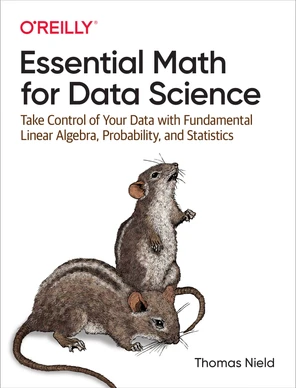
Book Essential Math for Data Science
Master the math needed to excel in data science, machine learning, and statistics. In this book author Thomas Nield guides you through areas like calculus, probability, linear algebra, and statistics and how they apply to techniques like linear regression, logistic regression, and neural networks. Along the way you'll also gain practical insights into the state of data science and how to use those insights to maximize your career. Learn how to: Use Python code and libraries like SymPy, NumPy, and scikit-learn to explore essential mathematical concepts like calculus, linear algebra, statistics, and machine learning Understand techniques like linear regression, logistic regression, and neural networks in plain English, with minimal mathematical notation and jargon Perform descriptive statistics and hypothesis testing on a dataset to interpret p-values and statistical significance Manipulate vectors and matrices and perform matrix decomposition Integrate and build upon incremental knowledge of calculus, probability, statistics, and linear algebra, and apply it to regression models including neural networks Navigate practically through a data science career and avoid common pitfalls, assumptions, and biases while tuning your skill set to stand out in the job market
Book overview
A look at the structure and key facts of the book

Publication date
May 26, 2022

Edition
1 edition

Total chapters
8 chapters
Total pages
352 pages

Level
Intermediate to advanced

Master the math needed to excel in data science, machine learning, and statistics. In this book author Thomas Nield guides you through areas like calculus, probability, linear algebra, and statistics and how they apply to techniques like linear regression, logistic regression, and neural networks. Along the way you'll also gain practical insights into the state of data science and how to use those insights to maximize your career.
Learn how to:
- Use Python code and libraries like SymPy, NumPy, and scikit-learn to explore essential mathematical concepts like calculus, linear algebra, statistics, and machine learning
- Understand techniques like linear regression, logistic regression, and neural networks in plain English, with minimal mathematical notation and jargon
- Perform descriptive statistics and hypothesis testing on a dataset to interpret p-values and statistical significance
- Manipulate vectors and matrices and perform matrix decomposition
- Integrate and build upon incremental knowledge of calculus, probability, statistics, and linear algebra, and apply it to regression models including neural networks
- Navigate practically through a data science career and avoid common pitfalls, assumptions, and biases while tuning your skill set to stand out in the job market
Browse this section to get a quick overall picture of the book's content.
Mathematical Foundations of Machine Learning
This section explores the vital role of Calculus and Linear Algebra in developing machine learning models. Readers learn how concepts like partial derivatives and matrix operations form the backbone of optimization algorithms. Topics include:
- Application of Gradient Descent in training models.
- The role of Basis Vectors in linear transformations.
- Practical implementation of these concepts using Python libraries.
Statistics and Data-Driven Inference
This section focuses on using Descriptive Statistics and Inferential Statistics to analyze datasets. The primary emphasis is on understanding statistical significance and how to interpret model results. Key topics include:
- Understanding the Central Limit Theorem and its application.
- How to calculate and interpret P-Values and confidence intervals.
- Performing Hypothesis Testing to validate statistical models.
The authors behind this book are among the most prominent experts and pioneers of their field. Their work is the result of years of hands-on experience, deep research and collaboration with the world's largest technology organizations and companies.Each of these authors, through specialist books and articles, has played an important role in shaping and advancing technical knowledge worldwide.

Comments
Readers' experience with this book - comments from buyers and other users
8 chapters in production
Reading time
09:15
Book type
Subscription
Participants
Be the first
Last updated
Sep 30, 2026