

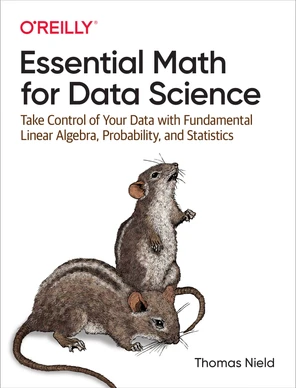
Book Essential Math for Data Science
Master the math needed to excel in data science, machine learning, and statistics. In this book author Thomas Nield guides you through areas like calculus, probability, linear algebra, and statistics and how they apply to techniques like linear regression, logistic regression, and neural networks. Along the way you'll also gain practical insights into the state of data science and how to use those insights to maximize your career. Learn how to: Use Python code and libraries like SymPy, NumPy, and scikit-learn to explore essential mathematical concepts like calculus, linear algebra, statistics, and machine learning Understand techniques like linear regression, logistic regression, and neural networks in plain English, with minimal mathematical notation and jargon Perform descriptive statistics and hypothesis testing on a dataset to interpret p-values and statistical significance Manipulate vectors and matrices and perform matrix decomposition Integrate and build upon incremental knowledge of calculus, probability, statistics, and linear algebra, and apply it to regression models including neural networks Navigate practically through a data science career and avoid common pitfalls, assumptions, and biases while tuning your skill set to stand out in the job market
Book preface
Before you start, a short look at what you will learn in this book
In the preface, settle the general questions you have at a glance, so your view widens and your choice is more informed. Questions such as: Why was this book written and what problem does it solve? Who can use the book? A summary of the chapters and the learning goals of each part? The important changes and new improvements added across editions, and so on — we cover all of these for you.
Target audience
Data analysts who want to strengthen their mathematical knowledge to better understand machine learning models.
Software developers who intend to enter the field of data science and artificial intelligence.
Technical students looking to learn the practical application of statistics and linear algebra in programming environments.
Data science professionals seeking a deeper understanding of how regression algorithms and neural networks function.
Why the book was written
This book is designed to bridge the gap between mathematical theories and their practical application in real-world data science projects.
The primary goal is to empower professionals to understand the logic behind machine learning algorithms without needing to memorize complex formulas.
This work helps readers transform abstract concepts into executable code using standard Python libraries.
The book provides guidance on managing a career path and avoiding common pitfalls in data-driven work environments.
Content overview
This book takes a pragmatic approach, transforming mathematics from an abstract subject into a practical tool for data professionals.
The author's explanations of complex concepts like neural networks are very clear and accessible to non-mathematician audiences.
Combining theoretical instruction with Python coding examples makes the learning process highly enjoyable and effective for the reader.
The sections on career advice provide added value that distinguishes this book from other similar educational resources.
8 chapters in production
Reading time
09:15
Book type
Subscription
Participants
Be the first
Last updated
Sep 30, 2026