

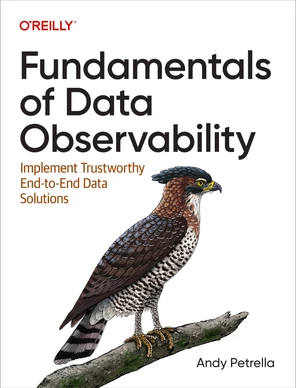
Book Fundamentals of Data Observability
Quickly detect, troubleshoot, and prevent a wide range of data issues through data observability, a set of best practices that enables data teams to gain greater visibility of data and its usage. If you're a data engineer, data architect, or machine learning engineer who depends on the quality of your data, this book shows you how to focus on the practical aspects of introducing data observability in your everyday work. Author Andy Petrella helps you build the right habits to identify and solve data issues, such as data drifts and poor quality, so you can stop their propagation in data applications, pipelines, and analytics. You'll learn ways to introduce data observability, including setting up a framework for generating and collecting all the information you need. Learn the core principles and benefits of data observability Use data observability to detect, troubleshoot, and prevent data issues Follow the book's recipes to implement observability in your data projects Use data observability to create a trustworthy communication framework with data consumers Learn how to educate your peers about the benefits of data observability
Book chapters
Browse the chapters to quickly get to know the structure and content of the book.
By browsing the chapters of this book you can quickly see what each part teaches, how the whole is structured and where to start. Each chapter focuses on one concept or skill, and you see its main topics so your choice is more informed. Whether you follow the whole book or just one part, this view helps you find your way.
Part I. Introducing Data Observability
This section introduces the foundational concepts of data observability and its critical role in modern data organizations.
As data teams scale, they face organizational complexities, segregated roles, and various data quality issues that can stall AI roadmaps.
This part explores the anatomy of these data issues and their consequences on team dynamics.
It details how data observability can rescue teams by enabling low-latency detection, efficient troubleshooting, and proactive prevention of data issues.
Readers will also learn about the core components of observability, including logs, traces, metrics, and the observations model across physical, static, and dynamic spaces.
Finally, it discusses how observability fits into modern data architectures, supporting concepts like Data Mesh's data products.
Introducing Data Observability
Components of Data Observability
Roles of Data Observability in a Data Organization
Part II. Implementing Data Observability
This section focuses on the practical implementation of data observability within your data pipelines.
It starts by demonstrating how to generate data observations at the source using a low-level Python API, detailing pipeline status, contextual data, and lineage-related observations.
The chapters then explore automation strategies, comparing event listeners, aspect-oriented programming, and high-level low-code or no-code applications.
Finally, it covers the implementation of expectations to achieve shift-left data quality, discover corner cases, and lift service level indicators.
Readers will learn overarching practices such as failing fast and safe, simplifying tests, and extending CI/CD pipelines to maintain expectations over time.
Generate Data Observations
Automate the Generation of Data Observations
Implementing Expectations
Part III. Data Observability in Action
This section showcases data observability in action across various stages of the data stack, including ingestion, transformation, serving, and analytics.
It provides practical recipes for integrating observability with popular tools such as Airbyte, Apache Spark, dbt, BigQuery, and Airflow.
The chapters also address the critical challenge of dealing with opaque systems, such as SaaS and inherited legacy platforms.
It offers strategies for achieving data translucence, including building a custom data observability connector.
A complete walkthrough of building a dbt data observability connector for SaaS environments is provided to illustrate these concepts in a real-world scenario.
Integrating Data Observability in Your Data Stack
Making Opaque Systems Translucent
8 chapters in production
Reading time
07:15
Book type
Subscription
Participants
Be the first
Last updated
Sep 30, 2026