

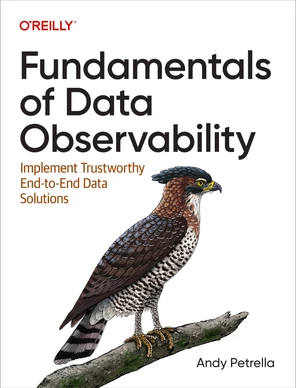
Book Fundamentals of Data Observability
Quickly detect, troubleshoot, and prevent a wide range of data issues through data observability, a set of best practices that enables data teams to gain greater visibility of data and its usage. If you're a data engineer, data architect, or machine learning engineer who depends on the quality of your data, this book shows you how to focus on the practical aspects of introducing data observability in your everyday work. Author Andy Petrella helps you build the right habits to identify and solve data issues, such as data drifts and poor quality, so you can stop their propagation in data applications, pipelines, and analytics. You'll learn ways to introduce data observability, including setting up a framework for generating and collecting all the information you need. Learn the core principles and benefits of data observability Use data observability to detect, troubleshoot, and prevent data issues Follow the book's recipes to implement observability in your data projects Use data observability to create a trustworthy communication framework with data consumers Learn how to educate your peers about the benefits of data observability
Book preface
Before you start, a short look at what you will learn in this book
In the preface, settle the general questions you have at a glance, so your view widens and your choice is more informed. Questions such as: Why was this book written and what problem does it solve? Who can use the book? A summary of the chapters and the learning goals of each part? The important changes and new improvements added across editions, and so on — we cover all of these for you.
Target audience
Data engineers who are responsible for building and maintaining reliable data pipelines will find this book highly valuable. It provides them with practical tools and Python APIs to generate contextual observations. This helps them detect and troubleshoot pipeline failures much faster.
Data architects looking to design robust, observable data architectures will benefit from the architectural patterns discussed. The book explains where observability fits within modern data architectures, including support for Data Mesh's data products. It helps them establish solid data management and security undercurrents.
Machine learning engineers who depend heavily on high-quality data for training and inference will learn to prevent garbage-in, garbage-out scenarios. The book offers specific recipes for machine learning workflows to monitor data drift. This ensures the ongoing reliability of AI models in production.
Data team leaders and managers who want to improve collaboration and communication with data consumers will gain strategic insights. The book provides frameworks for setting expectations and educating peers about the benefits of observability. This helps in building a transparent and trustworthy data organization.
Why the book was written
Modern data teams face significant challenges when scaling, leading to organizational complexity and segregated roles. This book addresses these issues by introducing data observability as a core practice to restore visibility and trust. It provides a structured approach to prevent data issues from propagating through pipelines.
Data quality issues like data drift can severely impact AI roadmaps and decision-making processes. By implementing the practices in this book, organizations can establish decentralized data quality management. This ensures that data applications and analytics remain reliable and accurate.
The book bridges the gap between theoretical data governance and practical engineering workflows. It offers actionable recipes for integrating observability into popular tools like Apache Spark, dbt, and Airflow. This helps engineers move from reactive troubleshooting to proactive prevention.
Establishing a trustworthy communication framework with data consumers is critical for modern enterprises. This guide shows how data observability can be used to build and maintain this trust. It empowers teams to educate their peers and foster a data-driven culture.
Content overview
The book provides a highly practical and hands-on approach to introducing data observability into everyday workflows. It successfully balances theoretical concepts with concrete code examples and recipes. Readers will appreciate the clear focus on real-world tools like dbt, Spark, and Airflow.
It offers an excellent guide for scaling data teams and overcoming organizational complexity. The author clearly explains the anatomy of data issues and their impact on team dynamics. This makes it an essential read for organizations transitioning to decentralized data architectures.
The inclusion of advanced topics like shift-left data quality and automated anomaly detection is highly commendable. It teaches readers how to implement expectations and simplify testing within CI/CD pipelines. These practices are crucial for maintaining long-term data reliability.
By addressing the challenge of making opaque legacy and SaaS systems translucent, the book solves a major industry pain point. The step-by-step guide to building a dbt data observability connector is particularly valuable. It empowers teams to gain visibility even in highly restricted environments.
8 chapters in production
Reading time
07:15
Book type
Subscription
Participants
Be the first
Last updated
Sep 30, 2026