

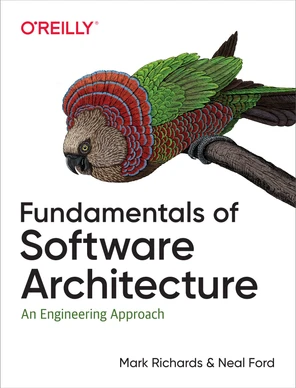
Book Fundamentals of Software Architecture
Salary surveys worldwide regularly place software architect in the top 10 best jobs, yet no real guide exists to help developers become architects. Until now. This book provides the first comprehensive overview of software architecture's many aspects. Aspiring and existing architects alike will examine architectural characteristics, architectural patterns, component determination, diagramming and presenting architecture, evolutionary architecture, and many other topics. Mark Richards and Neal Ford, hands-on practitioners who have taught software architecture classes professionally for years, focus on architecture principles that apply across all technology stacks. You'll explore software architecture in a modern light, taking into account all the innovations of the past decade. This book examines: Architecture patterns: The technical basis for many architectural decisions Components: Identification, coupling, cohesion, partitioning, and granularity Soft skills: Effective team management, meetings, negotiation, presentations, and more Modernity: Engineering practices and operational approaches that have changed radically in the past few years Architecture as an engineering discipline: Repeatable results, metrics, and concrete valuations that add rigor to software architecture
Book chapters
Browse the chapters to quickly get to know the structure and content of the book.
By browsing the chapters of this book you can quickly see what each part teaches, how the whole is structured and where to start. Each chapter focuses on one concept or skill, and you see its main topics so your choice is more informed. Whether you follow the whole book or just one part, this view helps you find your way.
Introduction
I. Foundations
To understand important trade-offs in architecture, developers must understand some basic concepts and terminology concerning components, modularity, coupling, and connascence.
Architectural Thinking
Modularity
Architecture Characteristics Defined
Identifying Architectural Characteristics
Measuring and Governing Architecture Characteristics
Scope of Architecture Characteristics
Component-Based Thinking
II. Architecture Styles
The difference between an architecture style and an architecture pattern can be confusing. We define an architecture style as the overarching structure of how the user interface and backend source code are organized (such as within layers of a monolithic deployment or separately deployed services) and how that source code interacts with a datastore. Architecture patterns, on the other hand, are lower-level design structures that help form specific solutions within an architecture style (such as how to achieve high scalability or high performance within a set of operations or between sets of services).
To understand important trade-offs in architecture, developers must understand some basic concepts and terminology concerning components, modularity, coupling, and connascence. Understanding architecture styles occupies much of the time and effort for new architects because they share importance and abundance.
Architects must understand the various styles and the trade-offs encapsulated within each to make effective decisions; each architecture style embodies a well-known set of trade-offs that help an architect make the right choice for a particular business problem.
Foundations
Layered Architecture Style
Pipeline Architecture Style
Microkernel Architecture Style
Service-Based Architecture Style
Event-Driven Architecture Style
Space-Based Architecture Style
Orchestration-Driven Service-Oriented Architecture
Microservices Architecture
Choosing the Appropriate Architecture Style
III. Techniques and Soft Skills
An effective software architect must not only understand the technical aspects of software architecture, but also the primary techniques and soft skills necessary to think like an architect, guide development teams, and effectively communicate the architecture to various stakeholders. This section of the book addresses the key techniques and soft skills necessary to become an effective software architect.
Architecture Decisions
Analyzing Architecture Risk
Diagramming and Presenting Architecture
Making Teams Effective
Negotiation and Leadership Skills
Developing a Career Path
Published
Reading time
11:26
Book type
Subscription
Participants
7 readers
Last updated
Sep 30, 2026