

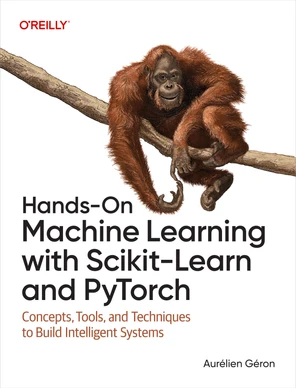
Book Hands-On Machine Learning with Scikit-Learn and PyTorch
The potential of machine learning today is extraordinary, yet many aspiring developers and tech professionals find themselves daunted by its complexity. Whether you're looking to enhance your skill set and apply machine learning to real-world projects or are simply curious about how AI systems function, this book is your jumping-off place. With an approachable yet deeply informative style, author Aurélien Géron delivers the ultimate introductory guide to machine learning and deep learning. Drawing on the Hugging Face ecosystem, with a focus on clear explanations and real-world examples, the book takes you through cutting-edge tools like Scikit-Learn and PyTorch—from basic regression techniques to advanced neural networks. Whether you're a student, professional, or hobbyist, you'll gain the skills to build intelligent systems. Understand ML basics, including concepts like overfitting and hyperparameter tuning Complete an end-to-end ML project using scikit-Learn, covering everything from data exploration to model evaluation Learn techniques for unsupervised learning, such as clustering and anomaly detection Build advanced architectures like transformers and diffusion models with PyTorch Harness the power of pretrained models—including LLMs—and learn to fine-tune them Train autonomous agents using reinforcement learning
Book overview
A look at the structure and key facts of the book

Publication date
October 23, 2025

Edition
1 edition

Total chapters
19 chapters

Total pages
878 pages
Level
Intermediate to advanced
The potential of machine learning today is extraordinary, yet many aspiring developers and tech professionals find themselves daunted by its complexity. Whether you're looking to enhance your skill set and apply machine learning to real-world projects or are simply curious about how AI systems function, this book is your jumping-off place.
With an approachable yet deeply informative style, author Aurélien Géron delivers the ultimate introductory guide to machine learning and deep learning. Drawing on the Hugging Face ecosystem, with a focus on clear explanations and real-world examples, the book takes you through cutting-edge tools like Scikit-Learn and PyTorch—from basic regression techniques to advanced neural networks. Whether you're a student, professional, or hobbyist, you'll gain the skills to build intelligent systems.
- Understand ML basics, including concepts like overfitting and hyperparameter tuning
- Complete an end-to-end ML project using scikit-Learn, covering everything from data exploration to model evaluation
- Learn techniques for unsupervised learning, such as clustering and anomaly detection
- Build advanced architectures like transformers and diffusion models with PyTorch
- Harness the power of pretrained models—including LLMs—and learn to fine-tune them
- Train autonomous agents using reinforcement learning
Browse this section to get a quick overall picture of the book's content.
Machine Learning Fundamentals and End-to-End Projects
This book covers the fundamentals of machine learning (ML), including key concepts like overfitting, hyperparameter tuning, and various types of learning systems. Readers will become familiar with the main challenges of machine learning, such as insufficient or poor-quality data, and how to test and validate models.
It also provides a step-by-step guide to completing an end-to-end ML project using Scikit-Learn. This includes various stages from data exploration and preparation to model selection and evaluation. This practical approach helps readers acquire the necessary skills to implement real-world projects.
Deep Learning with PyTorch and Advanced Architectures
This book delves deeply into neural networks and deep learning, offering a comprehensive guide to building and training models using PyTorch. Topics such as Convolutional Neural Networks (CNNs) for computer vision, Recurrent Neural Networks (RNNs) for sequence processing, and Transformers for natural language processing are covered.
It also explores advanced architectures like diffusion models and how to leverage pretrained models, including Large Language Models (LLMs), for fine-tuning. This section helps readers gain a profound understanding of how to design and implement complex AI systems.
Unsupervised and Reinforcement Learning Techniques
The book explores unsupervised learning techniques, including clustering with algorithms like k-means and DBSCAN, and anomaly detection using models such as Gaussian Mixtures. These methods are essential for discovering hidden patterns in data without the need for prior labeling.
Furthermore, it introduces the principles of reinforcement learning, used for training autonomous agents to make decisions in dynamic environments. This includes concepts like Policy Gradients and Q-Learning, enabling readers to build systems that can learn and improve through interaction with their environment.
Practical Application with Scikit-Learn and Hugging Face
This book emphasizes the practical application of industry-leading tools such as Scikit-Learn and PyTorch. Readers learn how to use these frameworks to implement various machine learning algorithms, from linear regression to more complex models.
Additionally, the Hugging Face ecosystem is introduced for natural language processing and leveraging pretrained models. This focus on real-world tools and practical examples ensures that readers can directly apply the acquired skills to their projects and build intelligent systems.
The authors behind this book are among the most prominent experts and pioneers of their field. Their work is the result of years of hands-on experience, deep research and collaboration with the world's largest technology organizations and companies.Each of these authors, through specialist books and articles, has played an important role in shaping and advancing technical knowledge worldwide.

Comments
Readers' experience with this book - comments from buyers and other users
Published
Reading time
26:37
Book type
Subscription
Participants
Be the first
Last updated
Nov 16, 2026