

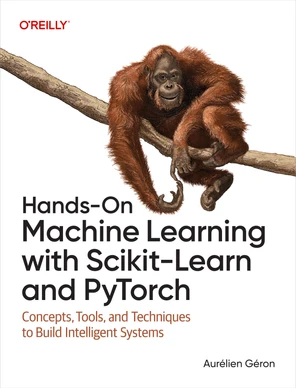
Book Hands-On Machine Learning with Scikit-Learn and PyTorch
The potential of machine learning today is extraordinary, yet many aspiring developers and tech professionals find themselves daunted by its complexity. Whether you're looking to enhance your skill set and apply machine learning to real-world projects or are simply curious about how AI systems function, this book is your jumping-off place. With an approachable yet deeply informative style, author Aurélien Géron delivers the ultimate introductory guide to machine learning and deep learning. Drawing on the Hugging Face ecosystem, with a focus on clear explanations and real-world examples, the book takes you through cutting-edge tools like Scikit-Learn and PyTorch—from basic regression techniques to advanced neural networks. Whether you're a student, professional, or hobbyist, you'll gain the skills to build intelligent systems. Understand ML basics, including concepts like overfitting and hyperparameter tuning Complete an end-to-end ML project using scikit-Learn, covering everything from data exploration to model evaluation Learn techniques for unsupervised learning, such as clustering and anomaly detection Build advanced architectures like transformers and diffusion models with PyTorch Harness the power of pretrained models—including LLMs—and learn to fine-tune them Train autonomous agents using reinforcement learning
Book chapters
Browse the chapters to quickly get to know the structure and content of the book.
By browsing the chapters of this book you can quickly see what each part teaches, how the whole is structured and where to start. Each chapter focuses on one concept or skill, and you see its main topics so your choice is more informed. Whether you follow the whole book or just one part, this view helps you find your way.
I. The Fundamentals of Machine Learning
This section lays the groundwork for understanding machine learning (ML), covering its core concepts and practical applications. It introduces various types of ML systems, including supervised, unsupervised, batch, and online learning, along with their main challenges such as overfitting and underfitting. Readers will learn to complete an end-to-end ML project using Scikit-Learn, from data exploration and preparation to model selection and evaluation. Key topics include classification, regression, decision trees, ensemble methods, and dimensionality reduction, providing a comprehensive foundation for building robust ML models. The section concludes with an exploration of unsupervised learning techniques like clustering and anomaly detection.
1. The Machine Learning Landscape
2. End-to-End Machine Learning Project
3. Classification
4. Training Models
5. Decision Trees
6. Ensemble Learning and Random Forests
7. Dimensionality Reduction
8. Unsupervised Learning Techniques
II. Neural Networks and Deep Learning
This section delves into the advanced realm of neural networks and deep learning, starting with the fundamentals of artificial neurons and multilayer perceptrons (MLPs). It provides a practical guide to building and training neural networks using PyTorch, covering topics from tensor operations and Autograd to implementing regression and classification MLPs. Readers will explore techniques for training deep neural networks, addressing challenges like vanishing/exploding gradients and overfitting, and utilizing optimizers and regularization methods. The section further expands into specialized architectures, including Convolutional Neural Networks (CNNs) for computer vision, Recurrent Neural Networks (RNNs) for sequence processing, and Transformers for natural language processing and chatbots. It also covers autoencoders, Generative Adversarial Networks (GANs), diffusion models, and reinforcement learning, offering a comprehensive journey into cutting-edge AI.
9. Introduction to Artificial Neural Networks
10. Building Neural Networks with PyTorch
11. Training Deep Neural Networks
12. Deep Computer Vision Using Convolutional Neural Networks
13. Processing Sequences Using RNNs and CNNs
14. Natural Language Processing with RNNs and Attention
15. Transformers for Natural Language Processing and Chatbots
16. Vision and Multimodal Transformers
17. Speeding Up Transformers
18. Autoencoders, GANs, and Diffusion Models
19. Reinforcement Learning
Published
Reading time
26:37
Book type
Subscription
Participants
Be the first
Last updated
Nov 16, 2026