

Book Hands-On RAG for Production
Retrieval-augmented generation (RAG) is the go-to strategy for integrating large language models with your organization's unique knowledge. However, the market is full of RAG pipelines and components, making it hard to choose the right solution for your enterprise's needs. This book simplifies the process, offering a comprehensive road map to building, refining, and scaling production-grade RAG applications. Authors Ofer Mendelevitch and Forrest Bao guide you through every phase of development, from data ingestion, embeddings, and vector search to advanced techniques like agentic RAG, multimodal RAG, and GraphRAG. Engineers and architects will learn how to tackle the challenges they'll encounter when building RAG applications at enterprise scale: ensuring high accuracy with minimal hallucinations, maintaining low-latency performance, safeguarding data privacy, and providing transparent, explainable responses among them.
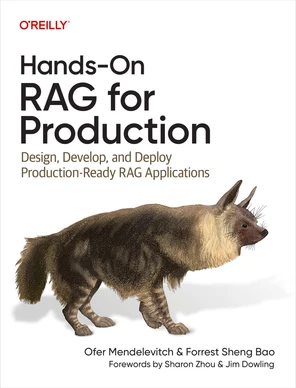
Book overview
A look at the structure and key facts of the book

Publication date
May 28, 2026

Edition
1 edition

Total chapters
10 chapters

Total pages
358 pages

Level
Intermediate to advanced
Retrieval-augmented generation (RAG) is the go-to strategy for integrating large language models with your organization's unique knowledge. However, the market is full of RAG pipelines and components, making it hard to choose the right solution for your enterprise's needs. This book simplifies the process, offering a comprehensive road map to building, refining, and scaling production-grade RAG applications.
Authors Ofer Mendelevitch and Forrest Bao guide you through every phase of development, from data ingestion, embeddings, and vector search to advanced techniques like agentic RAG, multimodal RAG, and GraphRAG. Engineers and architects will learn how to tackle the challenges they'll encounter when building RAG applications at enterprise scale: ensuring high accuracy with minimal hallucinations, maintaining low-latency performance, safeguarding data privacy, and providing transparent, explainable responses among them.
Browse this section to get a quick overall picture of the book's content.
RAG Architecture and Infrastructure
The book explores the core components of a RAG stack, including data ingestion and query flows. Readers learn how to handle document parsing, text chunking strategies, and the selection of appropriate embedding models. Additionally, the use of vector databases for similarity search and optimizing the performance of large language models (LLMs) is analyzed.
Scalability and Productionization
The focus is on the challenges of transitioning from a proof of concept to a production environment. This includes cost management, maintaining index freshness, and implementing guardrails for AI safety and security. Furthermore, evaluating response quality and mitigating hallucinations at an enterprise scale are discussed.
The authors behind this book are among the most prominent experts and pioneers of their field. Their work is the result of years of hands-on experience, deep research and collaboration with the world's largest technology organizations and companies.Each of these authors, through specialist books and articles, has played an important role in shaping and advancing technical knowledge worldwide.

Ofer Mendelevitch
Forrest Sheng Bao
Comments
Readers' experience with this book - comments from buyers and other users
Published
Reading time
10:52
Book type
Subscription
Participants
Be the first
Last updated
Nov 25, 2026