

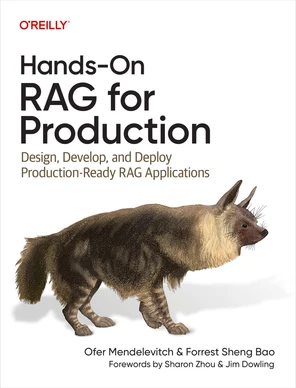
Book Hands-On RAG for Production
Retrieval-augmented generation (RAG) is the go-to strategy for integrating large language models with your organization's unique knowledge. However, the market is full of RAG pipelines and components, making it hard to choose the right solution for your enterprise's needs. This book simplifies the process, offering a comprehensive road map to building, refining, and scaling production-grade RAG applications. Authors Ofer Mendelevitch and Forrest Bao guide you through every phase of development, from data ingestion, embeddings, and vector search to advanced techniques like agentic RAG, multimodal RAG, and GraphRAG. Engineers and architects will learn how to tackle the challenges they'll encounter when building RAG applications at enterprise scale: ensuring high accuracy with minimal hallucinations, maintaining low-latency performance, safeguarding data privacy, and providing transparent, explainable responses among them.
Book preface
Before you start, a short look at what you will learn in this book
In the preface, settle the general questions you have at a glance, so your view widens and your choice is more informed. Questions such as: Why was this book written and what problem does it solve? Who can use the book? A summary of the chapters and the learning goals of each part? The important changes and new improvements added across editions, and so on — we cover all of these for you.
Target audience
Software engineers looking to implement RAG systems in production environments. These individuals need a deep understanding of architecture and infrastructure.
System architects responsible for designing and scaling AI applications in large organizations. They need to become familiar with integration and privacy challenges.
Data scientists who want to integrate large language models with their organization's proprietary knowledge. This book helps them with model selection and optimization.
Technical managers who intend to move their organization's AI strategies from proof of concept to production. This book helps them understand costs and team management.
Why the book was written
The book addresses the complexities of choosing the right components for a RAG stack in enterprise environments. It aims to simplify the decision-making process for engineers and architects.
By providing practical solutions, the book addresses critical challenges such as reducing hallucinations and improving response accuracy. This is essential for sensitive enterprise applications.
The book covers advanced techniques like multimodal RAG and GraphRAG, which are vital for modern AI systems. This content helps the reader move beyond basic implementations.
A special focus on scalability and data security makes this resource valuable for teams planning to bring their applications to production. It provides necessary guidance for managing costs and privacy.
Content overview
This book provides a comprehensive road map for navigating the complexities of the RAG market. Drawing on their practical experience, the authors explain difficult concepts in an accessible way.
The focus on advanced techniques like GraphRAG and multimodal RAG distinguishes this work from other resources. It is highly useful for those seeking modern implementations.
The sections on evaluation and observability of AI systems are essential for any production team. The book effectively demonstrates how to ensure system accuracy and security.
The excellent balance between theory and practical implementation makes this book a reference resource. The provided code examples make learning concepts much easier for engineers.
Published
Reading time
10:52
Book type
Subscription
Participants
Be the first
Last updated
Nov 25, 2026