

Book Infrastructure as Code, 3rd Edition
The past decade has seen cloud and infrastructure as code move out of shadow IT and startups and into the mainstream. Many organizations rushed to adopt new technologies as part of their transformation into digital businesses, creating a sprawl of unmaintainable infrastructure codebases. Now, there is a need to consolidate cloud-based systems into mature foundations for sustainable growth. With this book, Kief Morris describes patterns and practices for building and evolving infrastructure as code. The third edition provides a broader context for infrastructure, explaining how to design and implement infrastructure to better support the strategic goals and challenges of an organization, such as supporting growth while better managing costs. This book covers: Foundational concepts, including an exploration of declarative and procedural infrastructure languages, where infrastructure code fits into a comprehensive platform strategy and enterprise architecture, and how to test and deliver infrastructure code. Infrastructure architecture, drawing on lessons learned from software design and engineering to build infrastructure codebases that can be evolved and scaled to enable growth and adapt to changing needs. Patterns for building infrastructure to support platform services across the complicated, varied landscapes of real-world IT systems, from physical hardware to virtual servers to cloud-native clusters and serverless workloads. Workflows and operating models that combine automation and cloud with forward-thinking approaches like Agile and DevOps for rigorous governance of compliance, cost, security, and operational quality.
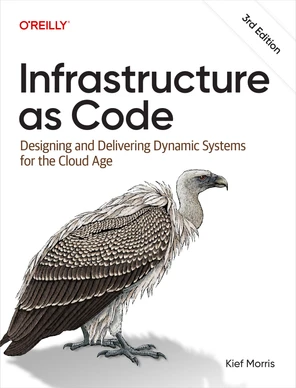
Book overview
A look at the structure and key facts of the book

Publication date
March 14, 2025

Edition
3 edition

Total chapters
21 chapters

Total pages
436 pages

Level
Intermediate to advanced

The past decade has seen cloud and infrastructure as code move out of shadow IT and startups and into the mainstream. Many organizations rushed to adopt new technologies as part of their transformation into digital businesses, creating a sprawl of unmaintainable infrastructure codebases. Now, there is a need to consolidate cloud-based systems into mature foundations for sustainable growth.
With this book, Kief Morris describes patterns and practices for building and evolving infrastructure as code. The third edition provides a broader context for infrastructure, explaining how to design and implement infrastructure to better support the strategic goals and challenges of an organization, such as supporting growth while better managing costs.
This book covers:
- Foundational concepts, including an exploration of declarative and procedural infrastructure languages, where infrastructure code fits into a comprehensive platform strategy and enterprise architecture, and how to test and deliver infrastructure code.
- Infrastructure architecture, drawing on lessons learned from software design and engineering to build infrastructure codebases that can be evolved and scaled to enable growth and adapt to changing needs.
- Patterns for building infrastructure to support platform services across the complicated, varied landscapes of real-world IT systems, from physical hardware to virtual servers to cloud-native clusters and serverless workloads.
- Workflows and operating models that combine automation and cloud with forward-thinking approaches like Agile and DevOps for rigorous governance of compliance, cost, security, and operational quality.
Browse this section to get a quick overall picture of the book's content.
Foundational Concepts of Infrastructure as Code
This section delves into the fundamental concepts of Infrastructure as Code (IaC). Readers will become familiar with declarative and procedural infrastructure languages, understanding how infrastructure code fits into a comprehensive platform strategy and enterprise architecture. Furthermore, it covers methods for testing and delivering infrastructure code to ensure quality and reliability.
Infrastructure Architecture and Design
This book applies lessons learned from software design and engineering to build robust infrastructure codebases. The goal is to create infrastructures that can evolve and scale, enabling business growth and adapting to changing needs. This approach helps organizations design their systems to be resilient and sustainable.
Patterns for Building Infrastructure for Platform Services
This section provides practical patterns for building infrastructure that supports platform services across the complicated, varied landscapes of real-world IT systems. These patterns cover a wide range of environments, from physical hardware and virtual servers to cloud-native clusters and serverless workloads. The aim is to offer actionable guidance for implementing infrastructure in diverse scenarios.
Advanced Workflows and Operating Models
The book explores workflows and operating models that combine automation and cloud with forward-thinking approaches like Agile and DevOps. This combination is crucial for rigorous governance of compliance, cost, security, and operational quality. This section helps organizations optimize their processes and adopt best practices in infrastructure management.
The authors behind this book are among the most prominent experts and pioneers of their field. Their work is the result of years of hands-on experience, deep research and collaboration with the world's largest technology organizations and companies.Each of these authors, through specialist books and articles, has played an important role in shaping and advancing technical knowledge worldwide.

Comments
Readers' experience with this book - comments from buyers and other users
21 chapters in production
Reading time
11:55
Book type
Subscription
Participants
Be the first
Last updated
Sep 30, 2026