

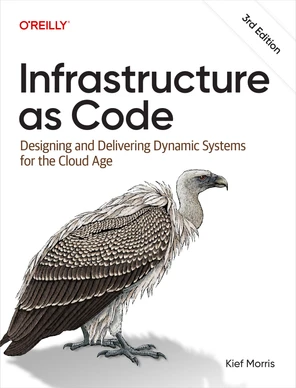
Book Infrastructure as Code, 3rd Edition
The past decade has seen cloud and infrastructure as code move out of shadow IT and startups and into the mainstream. Many organizations rushed to adopt new technologies as part of their transformation into digital businesses, creating a sprawl of unmaintainable infrastructure codebases. Now, there is a need to consolidate cloud-based systems into mature foundations for sustainable growth. With this book, Kief Morris describes patterns and practices for building and evolving infrastructure as code. The third edition provides a broader context for infrastructure, explaining how to design and implement infrastructure to better support the strategic goals and challenges of an organization, such as supporting growth while better managing costs. This book covers: Foundational concepts, including an exploration of declarative and procedural infrastructure languages, where infrastructure code fits into a comprehensive platform strategy and enterprise architecture, and how to test and deliver infrastructure code. Infrastructure architecture, drawing on lessons learned from software design and engineering to build infrastructure codebases that can be evolved and scaled to enable growth and adapt to changing needs. Patterns for building infrastructure to support platform services across the complicated, varied landscapes of real-world IT systems, from physical hardware to virtual servers to cloud-native clusters and serverless workloads. Workflows and operating models that combine automation and cloud with forward-thinking approaches like Agile and DevOps for rigorous governance of compliance, cost, security, and operational quality.
Book preface
Before you start, a short look at what you will learn in this book
In the preface, settle the general questions you have at a glance, so your view widens and your choice is more informed. Questions such as: Why was this book written and what problem does it solve? Who can use the book? A summary of the chapters and the learning goals of each part? The important changes and new improvements added across editions, and so on — we cover all of these for you.
Target audience
IT professionals and engineers grappling with the management of complex cloud infrastructures and the sprawl of Infrastructure as Code are the primary audience for this book. It offers practical solutions.
Architects and developers looking to design scalable and evolvable infrastructure codebases using software design principles will benefit from this book. It helps them implement best practices.
Organizations aiming to consolidate their cloud-based systems into mature foundations for sustainable growth and better cost management will find this book highly beneficial. It provides strategic guidance.
Teams adopting Agile and DevOps approaches who require rigorous governance for compliance, security, and operational quality in their infrastructure will benefit from the content of this book.
Why the book was written
This book addresses the challenges of unmaintainable infrastructure codebases that have emerged in the wake of rapid cloud adoption. This is crucial for organizations undergoing digital transformation.
It provides patterns and practices for building and evolving infrastructure as code, which are essential for sustainable growth and effective management of cloud-based systems. This guidance helps organizations optimize their infrastructure.
The book helps organizations design and implement infrastructure to support strategic goals and organizational challenges, such as fostering growth and better managing costs. This approach offers a holistic perspective.
This comprehensive guide covers foundational concepts, architecture, building patterns, and operating models for modern IT systems. This content is invaluable for anyone working with cloud infrastructure.
Content overview
This book offers a timely and essential guide for organizations navigating the complexities of cloud and infrastructure as code. It addresses the common pitfalls of rapid adoption, such as unmaintainable codebases.
It provides practical patterns and practices for designing, building, and evolving infrastructure, making it a valuable resource for achieving sustainable growth and managing costs effectively. The third edition expands on strategic goals.
Readers will find comprehensive coverage of foundational concepts, architectural design principles, and various patterns for building infrastructure across diverse IT landscapes. This includes everything from physical hardware to serverless workloads.
The book also delves into modern workflows and operating models, integrating automation with Agile and DevOps to ensure robust governance. It is a critical read for maturing cloud-based systems and operational quality.
21 chapters in production
Reading time
11:55
Book type
Subscription
Participants
Be the first
Last updated
Sep 30, 2026