

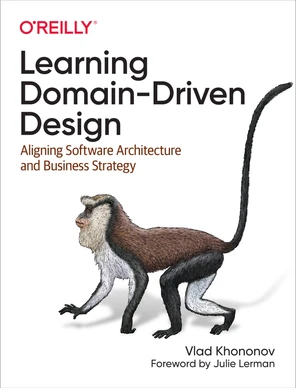
Book Learning Domain-Driven Design
Building software is harder than ever. As a developer, you not only have to chase ever-changing technological trends but also need to understand the business domains behind the software. This practical book provides you with a set of core patterns, principles, and practices for analyzing business domains, understanding business strategy, and, most importantly, aligning software design with its business needs. Author Vlad Khononov shows you how these practices lead to robust implementation of business logic and help to future-proof software design and architecture. You'll examine the relationship between domain-driven design (DDD) and other methodologies to ensure you make architectural decisions that meet business requirements. You'll also explore the real-life story of implementing DDD in a startup company. With this book, you'll learn how to: Analyze a company's business domain to learn how the system you're building fits its competitive strategy Use DDD's strategic and tactical tools to architect effective software solutions that address business needs Build a shared understanding of the business domains you encounter Decompose a system into bounded contexts Coordinate the work of multiple teams Gradually introduce DDD to brownfield projects
Book chapters
Browse the chapters to quickly get to know the structure and content of the book.
By browsing the chapters of this book you can quickly see what each part teaches, how the whole is structured and where to start. Each chapter focuses on one concept or skill, and you see its main topics so your choice is more informed. Whether you follow the whole book or just one part, this view helps you find your way.
I. Strategic Design
The domain-driven design (DDD) methodology can be divided into two main parts: strategic design and tactical design. The strategic aspect of DDD deals with answering the questions of “what?” and “why?”—what software we are building and why we are building it. The tactical part is all about the “how”—how each component is implemented.
We will begin our journey by exploring domain-driven design patterns and principles of strategic design:
- In Chapter 1, you will learn to analyze a company’s business strategy: what value it provides to its consumers and how it competes with other companies in the industry. We will identify finer-grained business building blocks, evaluate their strategic value, and analyze how they affect different software design decisions.
- Chapter 2 introduces domain-driven design’s essential practice for gaining an understanding of the business domain: the ubiquitous language. You will learn how to cultivate a ubiquitous language and use it to foster a shared understanding among all project-related stakeholders.
- Chapter 3 discusses another domain-driven design core tool: the bounded context pattern. You will learn why this tool is essential for cultivating a ubiquitous language and how to use it to transform discovered knowledge into a model of ...
1. Analyzing Business Domains
2. Discovering Domain Knowledge
3. Managing Domain Complexity
4. Integrating Bounded Contexts
II. Tactical Design
In Part I, we discussed the “what” and “why” of software: you learned to analyze business domains, identify subdomains and their strategic value, and turn the knowledge of business domains into the design of bounded contexts—software components implementing different models of the business domain.
In this part of the book, we will turn from strategy to tactics: the “how” of software design:
- In Chapters 5 through 7, you will learn business logic implementation patterns that allow the code to speak the ubiquitous language of its bounded context. Chapter 5 introduces two patterns that accommodate a relatively simple business logic: transaction script and active record. Chapter 6 moves to more challenging cases and presents the domain model pattern: DDD’s way of implementing complex business logic. In Chapter 7, you will learn to expand the domain model pattern by modeling the dimension of time.
- In Chapter 8, we will explore the different ways to organize a bounded context’s architecture: the layered architecture, ports & adapters, and CQRS patterns. You will learn the essence of each architectural pattern and in which cases each pattern should be used.
- Chapter 9 will discuss technical concerns and implementation strategies for orchestrating the interactions among components of a system. You will learn patterns supporting the implementation of bounded context integration patterns, how to implement reliable publishing of messages, and patterns for defining ...
5. Implementing Simple Business Logic
6. Tackling Complex Business Logic
7. Modeling the Dimension of Time
8. Architectural Patterns
9. Communication Patterns
III. Applying Domain-Driven Design in Practice
In Parts I and II, we discussed domain-driven design tools for making strategic and tactical design decisions. In this part of the book, we move from theory to practice. You will learn to apply domain-driven design in real-life projects.
- Chapter 10 merges what we discussed about strategic and tactical design into simple rules of thumb that streamline the process of making design decisions. You will learn to quickly identify patterns that match the business domain’s complexity and needs.
- In Chapter 11, we will look at domain-driven design from a different perspective. Designing a great solution is important, but not enough. We have to keep it in shape as the project evolves through time. In this chapter, you will learn to apply domain-driven design tools to maintain and evolve software design decisions over time.
- Chapter 12 introduces EventStorming: a hands-on activity that streamlines the process of discovering domain knowledge and building a ubiquitous language.
- Chapter 13 concludes Part III with a selection of tips and tricks for “gently” introducing and incorporating domain-driven design patterns and practices in brownfield projects—the kinds of projects we work on the most.
10. Design Heuristics
11. Evolving Design Decisions
12. EventStorming
13. Domain-Driven Design in the Real World
IV. Relationships to Other Methodologies and Patterns
So far in this book you’ve learned how to use domain-driven design to design software solutions according to an organization’s business strategy and needs. We saw how to apply DDD tools and practices to make sense of the business domain, design the boundaries of the system’s components, and implement the business logic.
Domain-driven design covers a lot of the software development lifecycle, but it can’t cover all of software engineering. Other methodologies and tools have their roles. In Part IV, we will discuss DDD in relation to other methodologies and patterns:
- It’s no secret that domain-driven design gained most of its traction due to the popularity of the microservices-based architectural style. In Chapter 14, we will explore the interplay between microservices and domain-driven design and how the two approaches complement each other.
- The event-driven architecture is a popular method of architecting scalable, performant, and resilient distributed systems. In Chapter 15, you will learn the principles of event-driven architecture and how to leverage DDD to design effective asynchronous communication.
- Chapter 16 concludes the book with effective modeling in the context of data analytics. You will learn about the predominant data management architectures, data warehouses and data lakes, and how their shortcomings are addressed by the data mesh architecture. We will also analyze and discuss how DDD and the data mesh ...
14. Microservices
15. Event-Driven Architecture
16. Data Mesh
16 chapters in production
Reading time
08:32
Book type
Subscription
Participants
Be the first
Last updated
Sep 30, 2026