

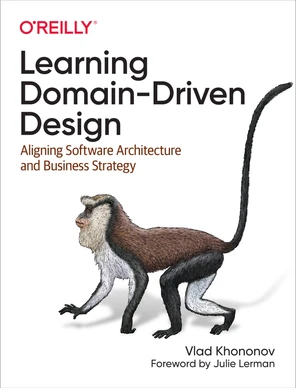
Book Learning Domain-Driven Design
Building software is harder than ever. As a developer, you not only have to chase ever-changing technological trends but also need to understand the business domains behind the software. This practical book provides you with a set of core patterns, principles, and practices for analyzing business domains, understanding business strategy, and, most importantly, aligning software design with its business needs. Author Vlad Khononov shows you how these practices lead to robust implementation of business logic and help to future-proof software design and architecture. You'll examine the relationship between domain-driven design (DDD) and other methodologies to ensure you make architectural decisions that meet business requirements. You'll also explore the real-life story of implementing DDD in a startup company. With this book, you'll learn how to: Analyze a company's business domain to learn how the system you're building fits its competitive strategy Use DDD's strategic and tactical tools to architect effective software solutions that address business needs Build a shared understanding of the business domains you encounter Decompose a system into bounded contexts Coordinate the work of multiple teams Gradually introduce DDD to brownfield projects
Book preface
Before you start, a short look at what you will learn in this book
In the preface, settle the general questions you have at a glance, so your view widens and your choice is more informed. Questions such as: Why was this book written and what problem does it solve? Who can use the book? A summary of the chapters and the learning goals of each part? The important changes and new improvements added across editions, and so on — we cover all of these for you.
Target audience
This book is ideal for software developers who are grappling with the increasing complexity of modern software systems. It helps them move beyond just coding to deeply understand the business context of their work.
Architects and technical leads will find this resource invaluable for making strategic design decisions that align with business goals. It provides tools to decompose systems effectively and coordinate work across multiple teams.
Anyone involved in "brownfield" projects, where Domain-Driven Design (DDD) needs to be gradually introduced into existing systems, will benefit from the practical guidance offered. The book addresses the challenges of evolving legacy designs.
Professionals interested in integrating DDD with other methodologies like microservices, event-driven architecture, or data mesh will find comprehensive explanations. It helps them design scalable and resilient distributed systems.
Why the book was written
This book addresses the growing complexity in software development, where developers must understand both technology and underlying business domains. It offers a structured approach to bridge this gap, ensuring software aligns with strategic business needs.
It provides a practical guide to Domain-Driven Design (DDD), offering core patterns and principles for analyzing business domains and understanding business strategy. The content is designed to help future-proof software design and architecture.
The book is essential for those looking to implement robust business logic and make informed architectural decisions that meet specific business requirements. It covers both strategic and tactical aspects of software design.
It offers a real-life perspective on implementing DDD in a startup, providing valuable insights into practical application and challenges. This makes the theoretical concepts more relatable and actionable for readers.
Content overview
This book serves as a comprehensive guide for mastering Domain-Driven Design, offering a clear path from understanding business domains to implementing complex business logic. It effectively bridges the gap between business strategy and software architecture.
Readers will appreciate the practical approach, which includes real-life examples and actionable patterns for analyzing business needs and designing effective software solutions. The emphasis on future-proofing designs is particularly valuable.
The book excels at explaining how to build a shared understanding of business domains and decompose systems into bounded contexts. It provides essential tools for managing complexity in large-scale software projects.
Its exploration of DDD's relationship with other modern architectural styles, such as microservices and event-driven architecture, makes it highly relevant for contemporary software development challenges. It offers insights into building robust and scalable systems.
16 chapters in production
Reading time
08:32
Book type
Subscription
Participants
Be the first
Last updated
Sep 30, 2026