

Book Learning Systems Thinking
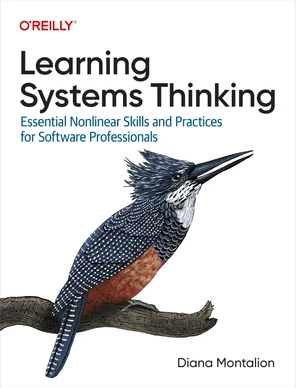
Welcome to the systems age, where software professionals are no longer building software; we're building systems of software. Change is continuously deployed across software ecosystems coordinated by responsive infrastructure. In this world of increasing relational complexity, we need to think differently. Many of our challenges are systemic. This book shows you how systems thinking can guide you through the complexity of modern systems. Rather than relying on traditional reductionistic approaches, author Diana Montalion shows you how to expand your skill set so we can think, communicate, and act as healthy systems. Systems thinking is a practice that improves your effectiveness and enables you to lead impactful change. Through a series of practices and real-world scenarios, you'll learn to shift your perspective in order to design, develop, and deliver better outcomes. You'll learn: How linear thinking limits your ability to solve system challenges Common obstacles to systems thinking and how to move past them New skills and practices that will transform how you think, learn, and lead Methods for thinking well with others and creating sound recommendations How to measure success in the midst of complexity and uncertainty
Book chapters
Browse the chapters to quickly get to know the structure and content of the book.
By browsing the chapters of this book you can quickly see what each part teaches, how the whole is structured and where to start. Each chapter focuses on one concept or skill, and you see its main topics so your choice is more informed. Whether you follow the whole book or just one part, this view helps you find your way.
A System of Thinking
This book is unabashedly about abstract thinking and reasoning. It describes practices, principles, tools, and ways of looking at your circumstances that increase your capacity for doing hard things. Software professionals are increasingly faced with relationally complex circumstances; these circumstances require systems thinking. Software is becoming systems of software. Here, you’ll find a system for thinking about systems.
We have been taught to think linearly. We need that skill to develop software. We also need to think nonlinearly and develop approaches that support us when our usual reductionistic approaches fail. As knowledge workers in the systems age, we are developing approaches that help us think about, and improve, the systems we design and deliver.
Our thinking generates the concepts that we rely on when designing our systems. When our concepts work together in harmony, supporting a system’s purpose, they have integrity. Fred Brooks says that “conceptual integrity is the most important consideration in systems design.” Without conceptual integrity, our software systems are built by “many good but independent and uncoordinated ideas.” Whether we recognize it or not, the coherence and interconnectedness of our concepts shape our technological systems.
To think in systems and create conceptual integrity, you need to become adept at shifting your perspective. Practices like learning, modeling with others, and discovering the root causes of ...
What Is Systems Thinking?
Crafting Conceptual Integrity
Shifting Your Perspective
You Are a System of Thinking
You can’t improve your thinking if you aren’t aware of your thinking. There are many factors that influence our ability to create conceptual integrity. Self-awareness, also known as metacognition, is the ability to understand and adapt your thinking patterns. Practicing with your own thinking is, perhaps unsurprisingly, the foundation of thinking in systems.
Most of the time, we are reacting to what’s happening around us, rather than practicing self-awareness and learning to respond effectively. This is not a bad thing; there is important information in our reactions. They rarely, though, get us what we need to improve our circumstances. Systems thinking shifts us toward observing the reactive patterns, in our selves, in others, and in the technology system, in order to discover ways to improve those reactive patterns.
Systems thinking is an integrative approach to learning. It is learning all the time, structuring inquiry in ways that generate relevant knowledge. In Part II, you’ll practice self-awareness, of your thinking and your reactions. And you’ll develop a plan for continuous learning that guides you toward knowledge, understanding, and, with any luck, a bit of wisdom.
Self-Awareness as a Foundational Skill
Replace Reacting with Responding
A System of Learning
We Are a System of Thinking
Systemic reasoning is the art and science of supporting ideas, concepts, recommendations, or theories with sound reasons. We need systemic reasoning when conditions are uncertain…and the vast majority of the time, in software systems, there is no One Right Way of doing things. There is only the best possible solution, under the circumstances, based on what we currently know. When people strengthen their reasoning together, they build conceptual integrity (and, therefore, more impactful systems).
Reasoning together depends on building conceptual bridges between different points of view. It also depends on learning from people with expertise you don’t have. We generate the flow of knowledge that improves systems thinking with feedback loops. Most of the time, this means we need to rethink the way “feedback” currently happens.
Systems thinking, reasoning, and discovering root causes of systemic challenges are all forms of pattern thinking. In many ways, pattern thinking is synonymous with systems thinking. In Part III, you will practice systemic reasoning, design feedback loops that improve your reasoning skills, and identify the types of patterns that, when thinking in systems, will usually demand our attention.
Collective Systemic Reasoning
Designing Feedback Loops
Pattern Thinking
Designing a System of Thinking
When we shift our linear thinking toward systems, we are shifting away from top-down thinking structures, ideas about management, and our usual definitions of success. Instead, we practice modeling, thinking well cross-functionally about how a system works and where it will benefit from our interventions. We provide systems leadership, encouraging an ecosystem where knowledge flow generates valuable impact. And we redefine our definitions of success to include the system as a whole.
In Part IV, you’ll practice modeling (which is not the same as diagramming). You’ll understand the paradigm we currently work in and how systems leadership shifts that paradigm. And you’ll look at systems success from a systems perspective, including the technology industry, a system we are all part of designing.
Modeling, Together
Systems Leadership
Redefining Success
12 chapters in production
Reading time
08:17
Book type
Subscription
Participants
Be the first
Last updated
Sep 30, 2026