

Book Learning Systems Thinking
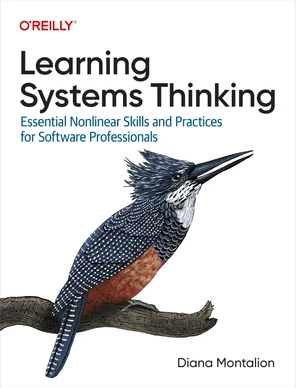
Welcome to the systems age, where software professionals are no longer building software; we're building systems of software. Change is continuously deployed across software ecosystems coordinated by responsive infrastructure. In this world of increasing relational complexity, we need to think differently. Many of our challenges are systemic. This book shows you how systems thinking can guide you through the complexity of modern systems. Rather than relying on traditional reductionistic approaches, author Diana Montalion shows you how to expand your skill set so we can think, communicate, and act as healthy systems. Systems thinking is a practice that improves your effectiveness and enables you to lead impactful change. Through a series of practices and real-world scenarios, you'll learn to shift your perspective in order to design, develop, and deliver better outcomes. You'll learn: How linear thinking limits your ability to solve system challenges Common obstacles to systems thinking and how to move past them New skills and practices that will transform how you think, learn, and lead Methods for thinking well with others and creating sound recommendations How to measure success in the midst of complexity and uncertainty
Book preface
Before you start, a short look at what you will learn in this book
In the preface, settle the general questions you have at a glance, so your view widens and your choice is more informed. Questions such as: Why was this book written and what problem does it solve? Who can use the book? A summary of the chapters and the learning goals of each part? The important changes and new improvements added across editions, and so on — we cover all of these for you.
Target audience
Software architects and engineers involved in designing, developing, and deploying complex software systems will find this book invaluable. It helps them understand the systemic nature of their work and apply systems thinking to create more robust and coherent architectures.
Technical leaders and managers who guide teams through complex technical challenges will benefit from the book's insights into systemic reasoning and impactful change. It provides tools for fostering conceptual integrity and effective collaboration within their teams.
Beyond software, the principles of systems thinking apply to various domains where interconnectedness and emergent properties are key. Professionals seeking to improve their problem-solving skills in complex, uncertain environments will find practical guidance.
The book encourages self-awareness and continuous learning as foundational skills for systems thinkers. It is suitable for those looking to expand their cognitive toolkit, improve their communication, and lead more effectively by understanding underlying system structures.
Why the book was written
The book is essential for professionals grappling with the shift from building individual software components to managing complex systems of software. It provides a framework for understanding and navigating the relational complexity inherent in continuously deployed, interconnected ecosystems.
It offers an alternative to reductionistic approaches that often fail in complex environments. The book aims to equip readers with systems thinking skills, enabling them to identify systemic challenges and develop more holistic solutions.
This resource is designed to enhance an individual's effectiveness and capacity to lead significant change within their organizations. By fostering a systems perspective, it helps professionals make sound recommendations and drive better outcomes across various initiatives.
The book emphasizes systems thinking as a continuous practice of learning and inquiry. It encourages readers to develop self-awareness and structured approaches to understanding complex situations, fostering a mindset of ongoing improvement and adaptation.
Content overview
This book offers a timely and crucial guide for navigating the intricate world of modern software development. It effectively articulates the need to move beyond linear thinking, providing a comprehensive framework for understanding and addressing systemic complexity. The practical exercises and real-world scenarios make the abstract concepts highly accessible and applicable.
"Learning Systems Thinking" serves as an excellent resource for professionals aiming to enhance their problem-solving capabilities in complex environments. It skillfully demonstrates how adopting a systems perspective can lead to more effective design, development, and delivery of solutions. The emphasis on collaborative reasoning and continuous learning is particularly valuable for fostering organizational health.
The author successfully demystifies systems thinking, presenting it not just as a theoretical concept but as a tangible practice for driving impactful change. Readers will appreciate the clear exposition of how to identify and overcome common obstacles to systemic understanding. It provides actionable strategies for improving communication and making robust, well-reasoned recommendations.
This work stands out for its focus on cultivating conceptual integrity within software systems and beyond. It challenges readers to rethink traditional notions of success and leadership, offering a holistic view that integrates individual self-awareness with collective reasoning. The book is a compelling argument for a more integrated and adaptive approach to modern challenges.
12 chapters in production
Reading time
08:17
Book type
Subscription
Participants
Be the first
Last updated
Sep 30, 2026