

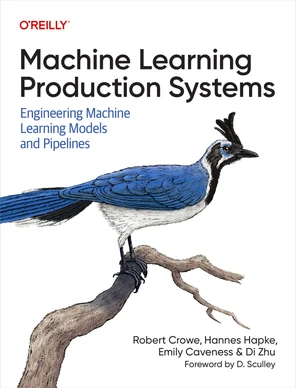
Book Machine Learning Production Systems
Using machine learning for products, services, and critical business processes is quite different from using ML in an academic or research setting—especially for recent ML graduates and those moving from research to a commercial environment. Whether you currently work to create products and services that use ML, or would like to in the future, this practical book gives you a broad view of the entire field. Authors Robert Crowe, Hannes Hapke, Emily Caveness, and Di Zhu help you identify topics that you can dive into deeper, along with reference materials and tutorials that teach you the details. You'll learn the state of the art of machine learning engineering, including a wide range of topics such as modeling, deployment, and MLOps. You'll learn the basics and advanced aspects to understand the production ML lifecycle. This book provides four in-depth sections that cover all aspects of machine learning engineering: Data: collecting, labeling, validating, automation, and data preprocessing; data feature engineering and selection; data journey and storage. Modeling: high performance modeling; model resource management techniques; model analysis and interoperability; neural architecture search. Deployment: model serving patterns and infrastructure for ML models and LLMs; management and delivery; monitoring and logging. Productionalizing: ML pipelines; classifying unstructured texts and images; genAI model pipelines.
Book overview
A look at the structure and key facts of the book

Publication date
October 8, 2024

Edition
1 edition

Total chapters
23 chapters

Total pages
474 pages

Level
Beginner to intermediate

Using machine learning for products, services, and critical business processes is quite different from using ML in an academic or research setting—especially for recent ML graduates and those moving from research to a commercial environment. Whether you currently work to create products and services that use ML, or would like to in the future, this practical book gives you a broad view of the entire field.
Authors Robert Crowe, Hannes Hapke, Emily Caveness, and Di Zhu help you identify topics that you can dive into deeper, along with reference materials and tutorials that teach you the details. You'll learn the state of the art of machine learning engineering, including a wide range of topics such as modeling, deployment, and MLOps. You'll learn the basics and advanced aspects to understand the production ML lifecycle.
This book provides four in-depth sections that cover all aspects of machine learning engineering:
- Data: collecting, labeling, validating, automation, and data preprocessing; data feature engineering and selection; data journey and storage.
- Modeling: high performance modeling; model resource management techniques; model analysis and interoperability; neural architecture search.
- Deployment: model serving patterns and infrastructure for ML models and LLMs; management and delivery; monitoring and logging.
- Productionalizing: ML pipelines; classifying unstructured texts and images; genAI model pipelines.
Browse this section to get a quick overall picture of the book's content.
Production ML Lifecycle
The book examines the entire lifecycle of a machine learning system from inception to production. The primary focus is on transitioning from experimental models to stable and scalable systems in an operational environment. This process includes:
- Data management and feature engineering.
- Optimizing models for production environments.
- Continuous deployment and monitoring of models.
Infrastructure and MLOps
A significant portion of the book is dedicated to the infrastructure required for serving models and implementing MLOps. The authors explore technical challenges at scale and the tools needed to manage pipelines. These topics include:
- Using containers and orchestration for deployment.
- Managing generative AI models and LLMs.
- Ensuring system reliability and availability.
The authors behind this book are among the most prominent experts and pioneers of their field. Their work is the result of years of hands-on experience, deep research and collaboration with the world's largest technology organizations and companies.Each of these authors, through specialist books and articles, has played an important role in shaping and advancing technical knowledge worldwide.


Comments
Readers' experience with this book - comments from buyers and other users
23 chapters in production
Reading time
13:56
Book type
Subscription
Participants
Be the first
Last updated
Sep 30, 2026