

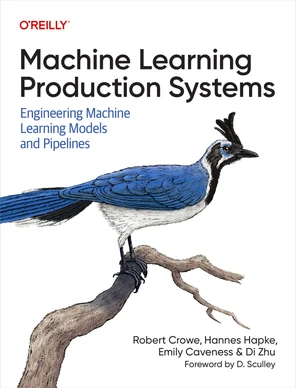
Book Machine Learning Production Systems
Using machine learning for products, services, and critical business processes is quite different from using ML in an academic or research setting—especially for recent ML graduates and those moving from research to a commercial environment. Whether you currently work to create products and services that use ML, or would like to in the future, this practical book gives you a broad view of the entire field. Authors Robert Crowe, Hannes Hapke, Emily Caveness, and Di Zhu help you identify topics that you can dive into deeper, along with reference materials and tutorials that teach you the details. You'll learn the state of the art of machine learning engineering, including a wide range of topics such as modeling, deployment, and MLOps. You'll learn the basics and advanced aspects to understand the production ML lifecycle. This book provides four in-depth sections that cover all aspects of machine learning engineering: Data: collecting, labeling, validating, automation, and data preprocessing; data feature engineering and selection; data journey and storage. Modeling: high performance modeling; model resource management techniques; model analysis and interoperability; neural architecture search. Deployment: model serving patterns and infrastructure for ML models and LLMs; management and delivery; monitoring and logging. Productionalizing: ML pipelines; classifying unstructured texts and images; genAI model pipelines.
Book preface
Before you start, a short look at what you will learn in this book
In the preface, settle the general questions you have at a glance, so your view widens and your choice is more informed. Questions such as: Why was this book written and what problem does it solve? Who can use the book? A summary of the chapters and the learning goals of each part? The important changes and new improvements added across editions, and so on — we cover all of these for you.
Target audience
Machine learning engineers who intend to move their models from research to operational environments. This book is excellent for those looking to understand production challenges.
Recent graduates in AI-related fields who want to become familiar with industry standards and MLOps. This book gives them a comprehensive view of the entire lifecycle.
Software developers working on ML-based products who need a better understanding of infrastructure and data pipelines. This book helps them build scalable systems.
Technical managers and system architects responsible for overseeing machine learning projects. This book assists them in making strategic decisions about tools and processes.
Why the book was written
This book bridges the gap between academic research and commercial machine learning implementations. It focuses on the real-world needs of engineers to build stable systems.
The topics help readers move from maintaining scattered models toward creating standardized, automated pipelines. This approach reduces bugs and increases the reproducibility of results.
By providing technical details on tools like TFX and cloud infrastructure, the book teaches the practical skills needed to manage models at scale. This knowledge is essential for any ML engineer in a production environment.
With the rise of generative AI, this book provides the necessary guidance for managing GenAI pipelines and their specific challenges. This is vital for staying current with modern technologies.
Content overview
This book is a comprehensive and practical guide for anyone who wants to implement machine learning professionally in commercial environments. The authors have well-balanced theory and practice.
The broad coverage of topics from data collection to model deployment and monitoring makes this book an essential reference for engineers. The content is presented in a very structured and accessible way.
The special focus on MLOps and the use of modern tools distinguishes this work from other similar books. The practical examples provided in the book are very useful for understanding complex concepts.
This book not only teaches the basics but also addresses advanced challenges such as generative AI and privacy. It is a valuable resource for keeping up with the rapid changes in the industry.
23 chapters in production
Reading time
13:56
Book type
Subscription
Participants
Be the first
Last updated
Sep 30, 2026