

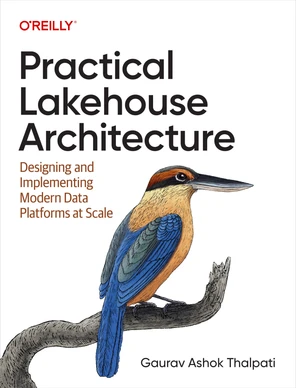
Book Practical Lakehouse Architecture
This concise yet comprehensive guide explains how to adopt a data lakehouse architecture to implement modern data platforms. It reviews the design considerations, challenges, and best practices for implementing a lakehouse and provides key insights into the ways that using a lakehouse can impact your data platform, from managing structured and unstructured data and supporting BI and AI/ML use cases to enabling more rigorous data governance and security measures. Practical Lakehouse Architecture shows you how to: Understand key lakehouse concepts and features like transaction support, time travel, and schema evolution Understand the differences between traditional and lakehouse data architectures Differentiate between various file formats and table formats Design lakehouse architecture layers for storage, compute, metadata management, and data consumption Implement data governance and data security within the platform Evaluate technologies and decide on the best technology stack to implement the lakehouse for your use case Make critical design decisions and address practical challenges to build a future-ready data platform Start your lakehouse implementation journey and migrate data from existing systems to the lakehouse
Book preface
Before you start, a short look at what you will learn in this book
In the preface, settle the general questions you have at a glance, so your view widens and your choice is more informed. Questions such as: Why was this book written and what problem does it solve? Who can use the book? A summary of the chapters and the learning goals of each part? The important changes and new improvements added across editions, and so on — we cover all of these for you.
Target audience
Data architects who need to design future-ready data platforms will find this book invaluable. It provides the architectural blueprints and guiding principles necessary to build scalable systems. Architects can use the step-by-step design guides to structure their projects.
Data engineers responsible for implementing and maintaining storage and compute layers will benefit from the technical depth. The book explains file and table formats like Delta Lake, Iceberg, and Hudi in detail. Engineers will learn how to optimize performance and manage metadata catalogs.
Data governance officers and security specialists looking to establish robust compliance frameworks will find practical solutions here. The book details unified governance processes, lineage tracking, and access management. It helps security teams protect sensitive data within a shared lakehouse environment.
IT managers and decision-makers evaluating technology stacks for modern data platforms will gain strategic insights. The comparative analyses of cloud services and third-party platforms assist in making informed purchasing decisions. It provides a clear picture of business outcomes and implementation costs.
Why the book was written
Traditional data architectures often struggle to handle the scale and variety of modern data workloads. This book provides a clear path forward by introducing the lakehouse architecture as a unified solution. It helps organizations bridge the gap between data lakes and data warehouses effectively.
Designing a modern data platform requires making complex choices regarding storage, compute, and table formats. This guide simplifies these decisions by offering structured comparisons and evaluation criteria. Readers will learn how to select the optimal technology stack for their specific use cases.
Data governance and security are frequently treated as afterthoughts in data platform implementations, leading to significant risks. This book places unified governance at the forefront of the design process. It provides practical strategies to secure sensitive data and maintain compliance.
Migrating existing legacy systems to a modern lakehouse architecture is a highly challenging endeavor. This resource outlines step-by-step design guides and real-world delivery phases to ensure a smooth transition. It prepares teams to handle historical data migration and reconciliation successfully.
Content overview
The book excels at demystifying complex architectural patterns by breaking them down into digestible layers. It provides a balanced view of theoretical concepts and practical implementation strategies. Readers will appreciate the clear comparisons between traditional and modern data platforms.
With its comprehensive coverage of open table formats, the guide serves as an essential reference for storage optimization. It helps technical professionals navigate the rapidly evolving ecosystem of Delta Lake, Iceberg, and Hudi. The benchmarking insights are particularly valuable for performance tuning.
The inclusion of real-world delivery phases, estimation guides, and design questionnaires makes this a highly actionable resource. It does not just explain what a lakehouse is, but details exactly how to build and migrate to one. This practical focus sets it apart from purely academic texts.
The author successfully addresses the critical but often ignored aspects of unified data and AI governance. By providing concrete examples of metadata management and access control, the book offers a complete blueprint for secure enterprise deployments. It is a must-read for anyone serious about modern data strategy.
9 chapters in production
Reading time
07:53
Book type
Subscription
Participants
Be the first
Last updated
Sep 30, 2026