

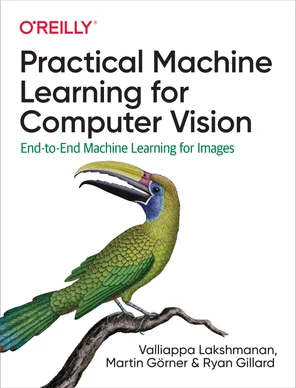
Book Practical Machine Learning for Computer Vision
This practical book shows you how to employ machine learning models to extract information from images. ML engineers and data scientists will learn how to solve a variety of image problems including classification, object detection, autoencoders, image generation, counting, and captioning with proven ML techniques. This book provides a great introduction to end-to-end deep learning: dataset creation, data preprocessing, model design, model training, evaluation, deployment, and interpretability. Google engineers Valliappa Lakshmanan, Martin Görner, and Ryan Gillard show you how to develop accurate and explainable computer vision ML models and put them into large-scale production using robust ML architecture in a flexible and maintainable way. You'll learn how to design, train, evaluate, and predict with models written in TensorFlow or Keras.
Book preface
Before you start, a short look at what you will learn in this book
In the preface, settle the general questions you have at a glance, so your view widens and your choice is more informed. Questions such as: Why was this book written and what problem does it solve? Who can use the book? A summary of the chapters and the learning goals of each part? The important changes and new improvements added across editions, and so on — we cover all of these for you.
Target audience
Machine learning engineers looking to improve their skills in computer vision. This book is ideal for those who are already familiar with basic concepts.
Data scientists who want to implement computer vision models at scale. This book introduces the necessary tools for production.
Software developers who intend to integrate deep learning into their products. The book provides a clear path for model deployment.
AI professionals looking to learn operational best practices (MLOps). This book focuses on model maintenance and monitoring.
Why the book was written
This book provides a practical guide for implementing computer vision models in real-world environments. It focuses on solving complex problems using modern tools.
Drawing on their experience at Google, the authors provide best practices for scaling and maintaining models. This approach is invaluable for professional engineers.
The book comprehensively covers everything from model design to deployment and monitoring. This end-to-end structure helps in gaining a deeper understanding of the development process.
Using popular frameworks like TensorFlow and Keras makes learning easier for developers. Practical examples help in understanding the concepts better.
Content overview
This book is a comprehensive and practical resource for anyone intending to pursue computer vision professionally. The authors have struck a great balance between theory and practice.
The book's end-to-end approach in covering the model lifecycle, from data collection to deployment, is highly valuable. This book is essential for engineering teams working with computer vision models.
The explanations regarding advanced architectures and model selection strategies are very precise and informative. Readers can use this knowledge to optimize their own models.
The book's focus on interpretability and ethics in AI sets it apart from other resources. This perspective is crucial for developing responsible systems.
12 chapters in production
Reading time
12:44
Book type
Subscription
Participants
Be the first
Last updated
Sep 30, 2026