

Book Practical Machine Learning for Computer Vision
This practical book shows you how to employ machine learning models to extract information from images. ML engineers and data scientists will learn how to solve a variety of image problems including classification, object detection, autoencoders, image generation, counting, and captioning with proven ML techniques. This book provides a great introduction to end-to-end deep learning: dataset creation, data preprocessing, model design, model training, evaluation, deployment, and interpretability. Google engineers Valliappa Lakshmanan, Martin Görner, and Ryan Gillard show you how to develop accurate and explainable computer vision ML models and put them into large-scale production using robust ML architecture in a flexible and maintainable way. You'll learn how to design, train, evaluate, and predict with models written in TensorFlow or Keras.
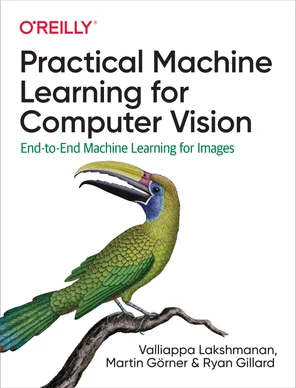
Book overview
A look at the structure and key facts of the book

Publication date
July 21, 2021

Edition
1 edition

Total chapters
12 chapters

Total pages
480 pages

Level
Intermediate to advanced

This practical book shows you how to employ machine learning models to extract information from images. ML engineers and data scientists will learn how to solve a variety of image problems including classification, object detection, autoencoders, image generation, counting, and captioning with proven ML techniques. This book provides a great introduction to end-to-end deep learning: dataset creation, data preprocessing, model design, model training, evaluation, deployment, and interpretability.
Google engineers Valliappa Lakshmanan, Martin Görner, and Ryan Gillard show you how to develop accurate and explainable computer vision ML models and put them into large-scale production using robust ML architecture in a flexible and maintainable way. You'll learn how to design, train, evaluate, and predict with models written in TensorFlow or Keras.
Browse this section to get a quick overall picture of the book's content.
Architecture and Design of Computer Vision Models
This book explores in detail how to design machine learning architectures for various computer vision tasks. Readers learn how to select appropriate models such as ResNet, SqueezeNet, or EfficientNet based on their specific project requirements. This section covers:
- Selecting optimal models for specific tasks.
- Utilizing modular and advanced architectures.
- Understanding the trade-offs between different models in performance and efficiency.
End-to-End Pipelines and Production Operations
The main focus of this section is on building a complete pipeline for training, evaluating, and deploying models into production environments. The authors emphasize the importance of interpretability and responsible AI practices. Key topics include:
- Preprocessing images for data augmentation.
- Deploying models as web services or on edge devices.
- Continuous monitoring and management of machine learning models after deployment.
The authors behind this book are among the most prominent experts and pioneers of their field. Their work is the result of years of hands-on experience, deep research and collaboration with the world's largest technology organizations and companies.Each of these authors, through specialist books and articles, has played an important role in shaping and advancing technical knowledge worldwide.



Comments
Readers' experience with this book - comments from buyers and other users
12 chapters in production
Reading time
12:44
Book type
Subscription
Participants
Be the first
Last updated
Sep 30, 2026